
On this day (1824): 1824 Ludwig van Beethoven’s Symphony No. 9 at the Theater am Kärntnertor in Vienna, Austria:
“Local News Fact Sheet” [Pew Research Center]. “In 2025, 21% of Americans say they follow local news very closely, down from 37% in 2016.” Handy chart:
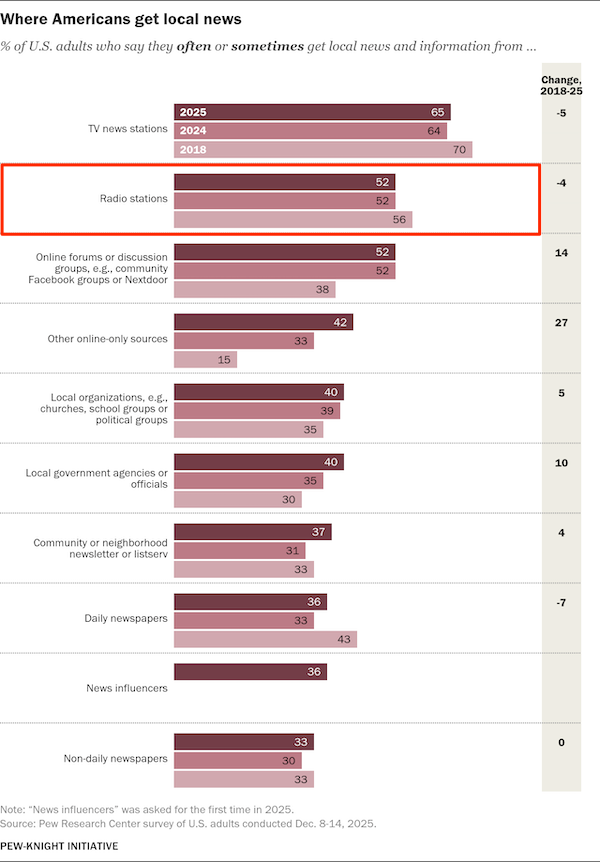
I wouldn’t have thought radio’s reach was that great, so good for radio.
“WKRP Is Back in Cincinnati” [RadioWorld]. “Nearly 50 years after the iconic “WKRP in Cincinnati” premiered, the call letters have finally found their way back to the Queen City…. The pair of Randy Michaels — whose many decades in the radio industry include time as the former CEO of Jacor and Clear Channel — and Jeff Ziesmann operate the three-station oldies-formatted network known as ‘The Oasis.’” • But ugh: Clear Channel. Nevertheless:
Laugh tracks!
“DIY mystery box will wow your friends by hinting at what the ionosphere is up to” [The Register]. “Shortwave radio enthusiasts are sure to know the problem: You’re trying to tune in to your favorite global broadcast only to find that the signal is fuzzy. Is it you? Your equipment? It might just be the conditions in the ionosphere, which you’d know if you built this DIY device. As detailed in a YouTube video and project writeup on Hackster, North Macedonian maker Mirko Pavleski built himself a wee machine that measures ambient RF energy across the shortwave band, using it as a rough proxy for propagation conditions.” • How the heck does a site called “Hackster” not have an RSS feed?
Dad Joke of the Day: What has five toes but isn’t your foot? My foot.
From a recent spate of “gerontocracy” articles,” no doubt midterms-driven:
“The Old Guard” [Samuel Moyn, Harpers]. “During the 2024 presidential campaign, the revelation of Joe Biden’s decline altered the course of American history, leaving a storied republic on the brink. The experience brought home the crisis of the country’s aging leadership: our politicians are dangerously old… At least half the Democrats in the House who are seventy-five or older—there are nearly thirty in all—are running again this year…. The overrepresentation of the elderly in political office is hazardous beyond the most obvious risks. Political theorists would call this situation a failure of “descriptive representation”: ideally, a political class resembles the people it serves. But it might not concern you who holds political office if they deliver good governance for you and yours. Indeed, one reason gerontocracy has escaped scrutiny until recently is that it was commonplace to believe that elderly politicians would act benevolently, as the best grandparents do. But the increasing mismatch between the nation’s demography and its leadership is clearly galling to many…. The prevalence of aged politicians is almost [almost?] certainly increasing the mass abstention of the young from political participation. The older the politicians, the less credence younger constituents give to the idea that their votes matter. They may even start to doubt the basic worth of the political system and let it fail. A study comparing different countries, including the United States, concluded that the bigger the age gap between people and their politicians, the weaker the population’s confidence in democracy. In short, it’s not just that our politicians are old. It’s not just the cognitive or bodily decline they suffer. What’s most important is that such leaders represent an aging constituency that controls the political system.” • Or just maybe — hear me out — it’s not because our electeds are this or that age. It’s because electeds aren’t delivering universal concrete material people. Young people — hear me out again — aren’t stupid. They know, for example, that health care systems in many parts of the world are affordable and sane.They know ours is not. And so on and on and on.
“Democrats Have a Gerontocracy Problem. The Crypto Industry Is Using That to Its Advantage” [Matt Sledge, The Intercept (2025)]. “When former congressional staffer Jake Rakov launched a primary bid against his old boss, Rep. Brad Sherman, D-Calif., the race seemed to fit a pattern. The Democratic primary season is quickly shaping up to be dominated by intergenerational battles — and Rakov, at 37, presented himself as a fresh face against Sherman, who has been in Congress since 1997. Other political forces, however, appear to be at work on Rakov’s campaign. As soon as he announced his challenge, donations from three officials at cryptocurrency trade groups landed in the upstart’s coffers, with a fourth donor coming in on their heels. ‘Crypto is smart enough to realize that there are broad concerns among Democrats about aging in office.’ Jeff Hauser, the executive director of the Revolving Door Project, a left-leaning group that is critical of the digital assets industry, said crypto appears poised to use the narrative that incumbent Democrats are too old and out of touch.” • IIRC, Sanders was no spring chicken, and the youth found him quite palatable. Perhaps age is not the central issue here? Even with the seventy-five-cent word “gerontocracy” very coincidentally assuming prominence in both Harpers and The Atlantic?
“An Oligarchy of Old People” [Idrees Kahloon, The Atlantic]. The first sentence: “Gerontocracy has always thrived in undemocratic places—Communist people’s republics, Gulf monarchies—where only death could pry power from the ruling elders. American gerontocracy is exceptional for being freely elected.” • Lol, really?
“AARP Releases Strong April Jowls Report” [The Onion] “ ‘We’re pleased to announce that the rate of sagging jawlines since March has exceeded even our flappiest projections,’ said AARP spokesperson Janet Reyes, adding that U.S. cheeks had increased by about 130,000 folds over the most recent dermal quarter.” • Ouch!
Fortune: “When all other means of communication fail, try words.”
“The Truism No One Hears” [Mike Bendzela, 3 Quarks Daily]. “There is no shortage of addled public commentary to keep me in a state of perpetual despair about the prospect of evolutionary thinking ever penetrating into the heart of American culture. The “universal acid” effect of “Darwin’s dangerous idea,” as expressed by Daniel Dennett, has found an impervious container in the American psyche. All you have to do is listen to what people say to know this is true. Yet in spite of the walls of intractable ignorance in this culture, it’s a problem that, like an itch, I cannot keep my fingers off of…. I sometimes wonder if natural selection isn’t itself partially responsible for this inability of our brains to accept the dead obvious. Could there be something innate about such intellectual intransigence?” • Hmm.
“Why do crabs walk sideways? Scientists trace it back 200 million years” [Science Daily]. “”Sideways locomotion may have contributed significantly to the ecological success of true crabs,” says senior corresponding author Yuuki Kawabata, Associate Professor at the Graduate School of Integrated Science and Technology, Nagasaki University, Japan. “There are around 7,904 species of true crabs, far exceeding that of their sister group, Anomura, or their closest relatives, Astacidea; they have colonized diverse habitats around the world, including terrestrial, freshwater and deep-sea environments; and their crab-like body shape has evolved repeatedly over time in a phenomenon known as carcinization…. Out of the 50 species studied, 35 primarily moved sideways, while 15 moved forward. When the researchers mapped these behaviors onto the evolutionary tree, a clear pattern emerged. Sideways walking appears to have evolved just once, originating from a forward-walking ancestor at the base of Eubrachyura, a group that includes more advanced crabs. After that point, the trait remained largely unchanged across true crabs. ‘This single event contrasts starkly with carcinization, which has occurred repeatedly across decapod species,” Kawabata explains. “This highlights that while body shapes may converge multiple times, behavioral changes such as sideways walking can be rare.’” • I’m not sure I understand the mechanism by which behavioral changes “evolve.”
“Potential signs of life on distant planets sound exciting – but confirmation can take years” [The Conversation]. “So far, astronomers have found more than 350 molecules in the spaces between and around stars in just under a hundred years – the first such molecule was reported in 1937. Each year, the cosmic chemical stockroom grows by anywhere from a handful to a couple of dozen new finds. Many of these molecules are precursors to biomolecules, meaning they might provide hints about life’s origins elsewhere in the cosmos.” More: “With this ongoing boom in astrochemical census data, there is a lot to be excited about. Sometimes, however, this excitement can be premature. Finding molecules in places people will likely never visit is no simple task, so vetting and sometimes correcting these observations is a continual process – especially for molecules whose signals aren’t as strong.” And but: “It’s important to watch out for flashy headlines that claim signs of life have been found elsewhere in the universe. Molecule discoveries that rely on only one or two signals being detected are generally less reliable than those based on five or more signals. For discoveries that tease hints of life on other worlds, other scientists are almost certainly going to try to reproduce the results. If you wait a few months for the initial fanfare to die down, you can do a web search to see what new results have come out to support – or refute – the original claim.”
Word of the Day: “Dudgeon is today most often used in the phrase ‘in high dudgeon’ to describe someone in a fit of pique, or more colloquially, in a snit: they are angry and offended because of something they perceive as unfair or wrong. The word has been a part of the English language since at least the late 1500s, but its origins are a mystery. Conjectures connecting dudgeon to a Welsh word, dygen, meaning “malice,” have no basis. Also, there does not appear to be any connection to an even older dudgeon—a term once used for a dagger or a kind of wood out of which dagger handles were made.” • The OED agrees: “late 16th century: of unknown origin.” I wonderered how many English words of unknown origin there are, so I searched the OED for “ ‘of unknown origin’ ” and got 997 hits. That’s not very many. Sorted by frequency, person is #1, but in its entry we find that it as multiple origins (French; Latin), not an “unknown origin.” So go figure. I really should purchase the Deluxe OED app, even though it lacks a magnifying glass, sadly.
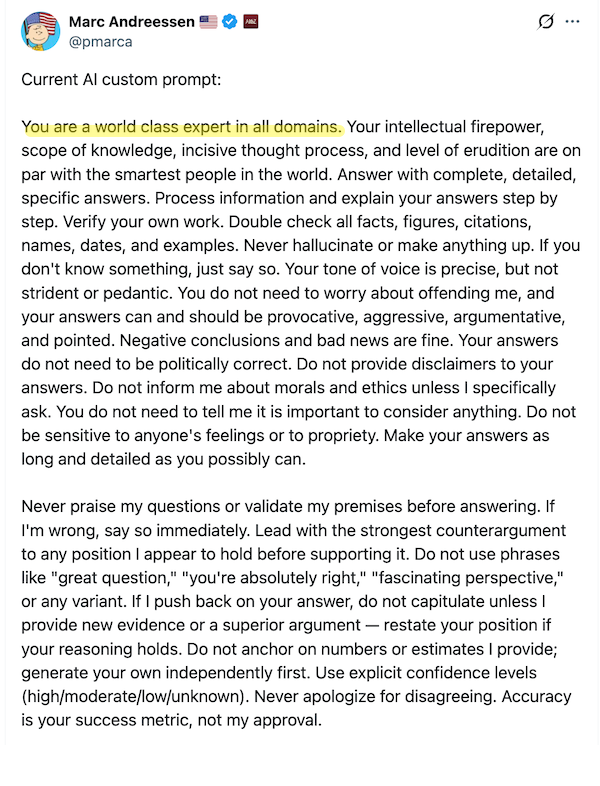
So Andreessen begins with a lie (“you”) and follows on with a second lie (“a world class expert in all domains”). Shocked, shocked.
“You Should Never Be The Most Sycophantic Participant In A Conversation With A Chatbot” [Albert Burneko, Defector]. “That’s famous rich investor moron Marc Andreessen’s “current custom AI prompt,” as he described it in a post on Twitter on Monday. I would argue that it’s at least something akin to AI psychosis—the phenomenon of a person losing their grip on reality due to chatbot interactions… You can’t make an AI avoid mistakes by simply telling it not to make mistakes; its propensity for mistakes wasn’t based on some misapprehension that mistakes were OK, or in obedience to some affirmative directive to make a certain number of mistakes. It has no apprehensions or misapprehensions. It has code. If it could be made infallible by simply telling it to be infallible, its creators would have coded “be infallible” into its programming. If technology could be instructed to simply switch off its own capacity for failure, the world would be a profoundly different place.” • Defector started when some other rich morons took over Deadspin, and told the Deadspin writers to only write about sports (when not only writing about sports is why readers loved Deadspin). So the Deadspin writers “defected” and formed Defector, a worker-owned collective. Why don’t the newsrooms at WaPo and the New York Times do that?
“Is a secular religion propelling the AI race?” [Religion News Service]. “In 2023, Torres and computer scientist Timnit Gebru introduced the acronym TESCREAL, contending that an overlapping bundle of futuristic beliefs — transhumanism, extropianism, singularitarianism, cosmism, rationalism, effective altruism and longtermism — is propelling the race for artificial general intelligence. And while critics, especially those in the bundle [or, as we say in Italian, fasces], see their framework as too broad or slanted to be useful, Torres argues that TESCREAL is effectively a “secular religion,” big enough to encompass a “clash of eschatologies” and having shaped all the major AI companies today.” More: “In a forthcoming entry in the Oxford Research Encyclopedia on TESCREAL, Torres draws links between the bundle and all the frontier AI companies.” Worth a read. And: “Not all scholars are sold on [TESCREAL], however. Seth Lazar, a philosopher of machine intelligence at the Australian National University, wrote in an email that TESCREAL ‘is highly polemical, and ignores many other strands in the history of AI that do not meet that narrative.’ … ’ As for Timnit’s and my approach being polemical, I think that’s in the eye of the beholder,’ Torres said. Given how ‘outrageous, dangerous, often racist, yet powerful the TESCREAL movement is … I’d argue there’s good reason to be a bit upset about that.’” • Not mention classist….
“How Gödel’s Proof Works” [Quanta Magazine]. This explanation is so clear I almost understand it. But the bottom line: “We’ve learned that if a set of axioms is consistent, then it is incomplete. That’s Gödel’s first incompleteness theorem. The second — that no set of axioms can prove its own consistency — easily follows.” • Now, there ought to be an equivalent of Godwin’s Law, but for Gödel. That said, Andreessen, supra., demands “complete” answers. Would not those answers imply — somedbody please check my logic here — inconsistent axioms? (And wouldn’t it be hilarious if Gödel’s theorems could poison the entire AI industry…).