
Like the (mythical) thieving magpie, I have a penchant for collecting and displaying small bright shiny objects (BSOs); hence my preference for aggregative genres. But what to call those objects? But it’s been a source of frustation for me that I could not find the right word to name them.
I considered snippet, which Merriam-Webster defines as “a small part, piece, or thing especially : a brief quotable passage.” That seems exactly on point: “brief quotable passage[s]” are exactly what I aggregate in Water Cooler (and now Words of the Day). I wouldn’t be aggregating them if they weren’t quotable and brief! But “snippet” lacks the quality that permits and attracts its discovery: I can only describe this quality as turning a small object, like a rock or a gem or a coin, over and over between thumb and fingers, determining texture, heft, quality, utility. That’s what it’s like when aggregating; and perhaps the same happens with with you, readers, when reading.
So I went looking for a word that captured this sense of the materiality of these small bright shiny objects. A friend suggested tessera: “in mosaic work, a small piece of stone, glass, ceramic, or other hard material cut in a cubical or some other regular shape.” But BSOs are, by definition, not regularly shaped. They are collected by a serendipitous walk through the discourse, no matter their shape. Further, tesserae are constructed for the very purpose of being assembled; but I am bending the BSOs to my purposes.
I considered tektites: “Tektites are rounded, pitted bodies of silicate glass, nonvolcanic in origin, most likely derived by large hypervelocity meteorite collisions with terrestrial rocks.” I like very much the image of a an event (a meteor) hitting the discourse (the rocks), and splashing out BSOs (the tektites), but in the end that origin story is too constricting. Tektites are found in “strewnfields”, where the impact took place. BSOs are found objects, randomly distributed. The world is my strewnfield!
Finally, at the suggestion of another friend, I considered glass beads, as in Herman Hesse’s The Glass Bead Game:
“These rules, the sign language and grammar of the Game, constitute a kind of highly developed secret language drawing upon several sciences and arts, but especially mathematics and music (and/or musicology), and capable of expressing and establishing interrelationships between the content and conclusions of nearly all scholarly disciplines. The Glass Bead Game is thus a mode of playing with the total contents and values of our culture; it plays with them as, say, in the great age of the arts a painter might have played with the colours on his palette.”
This I rejected too, trivially because I didn’t like the having to use two words (and “bead” alone didn’t do it for me, beads being, like tesserae, purpose-built), more seriously because if I had to choose a “secret language” (why secret?), it wouldn’t be the Game described by Hesse.
Then the mudlarks of Victorian London came to mind, I’m not sure why. From London Museum:
In the 18th and 19th centuries, poor Londoners sold scraps they found on the foreshore to earn any money they could. They became known as mudlarks.
Henry Mayhew, the social commentator, describes the mudlarks in the mid-19th century as “compelled from utter destitution to seek for the means of appeasing their hunger in the mud of the river”.
There are modern-day mudlarks, too, though you need a permit:
The mudlarks who search the shores of the river today do it as a rewarding hobby, not out of desperation.
Now mudlarks use their keen eyes, metal detectors and trowels in the hunt for objects, and they play an important role in preserving the city’s past.
All sorts have been found along the shore in London, including Bronze Age swords, Roman glass jewels and over 250 ancient human skeletal remains – including the skull of a Neolithic man which is over 5,500 years old.
Here is a modern-day mudlark’s BSO:
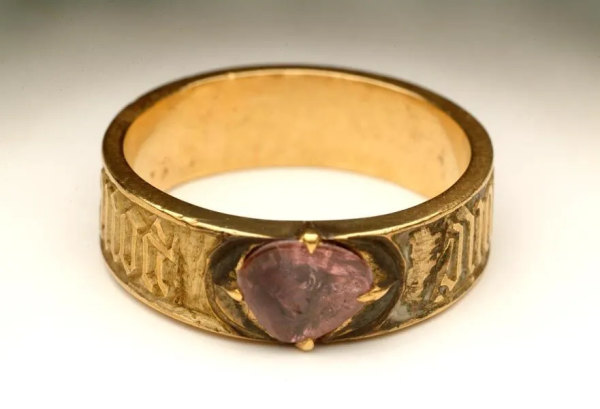
A medieval gold ring found on the Thames foreshore at Bankside.
The Victorian mudlark’s life was not easy:
Most mudlarks were generally boys between the ages of 6 and 15 years old. However, sometimes girls, women, and the decrepit also worked as mudlarks….. Working as a mudlark was not a pleasant job. In fact, it was a horrid, filthy job. Mudlarks generally worked shoeless, searching for paltry treasures, and dripping of filthy slush as they waded through rivers trying to avoid broken glass, human excrement, and even animal and human corpses. On the Thames, they would scour either side of the river, often crawling between barges and cover an area that ranged from Vauxhall bridge to Woolwich. As they traversed the shore of the Thames, they searched for a variety of things including coal, paper, wood chips, copper nails, scrap iron, and the occasional hat, old boot, or silk handkerchief.
Henry Mayhew’s London Labour and the London Poor (“A Cyclopædia Of The Condition And Earnings of Those That Will Work Those That Cannot Work, and Those That Will Not Work”) takes an even more jaundiced view:
They generally consist of boys and girls, varying in age from eight to fourteen or fifteen; with some persons of more advanced years. For the most part they are ragged, and in a very filthy state, and are a peculiar class, confined to the river. The parents of many of them are coalwhippers—Irish cockneys—employed getting coals out of the ships, and their mothers frequently sell fruit in the street. Their practice is to get between the barges, and one of them lifting the other up will knock lumps of coal into the mud, which they pick up afterwards; or if a barge is ladened with iron, one will get into it and throw iron out to the other, and watch an opportunity to carry away the plunder in bags to the nearest marine-storeshop.
And mudlarking takes some skill. This is a modern mudlark, but I see no reason why the principle wouldn’t apply in the Victorian era:
As my eyes adjusted to searching, I saw how rich this small patch of ground was.
Here’s the key to success: Use the same gaze as you would for Where’s Waldo or a challenging jigsaw puzzle. Look slowly, and let the objects emerge from the background.
In 40 minutes I had pipe stems, pottery, an oyster shell, and a metal spike with a square rivet sticking out. There was a possible cup handle resembling a stem with leaves, like a museum piece from the 1700s.
But I wander. What did the Victorian mudlarks call their BSOs? (I guess down in the mud they are not that shiny, except in value anticipated.) Mayhew interviews one; his word seems to be “piece”, but I’m not sure if he’s generalizing at all (“piece”, “article”, “a shilling’s worth”):
About two years ago I left school, and commenced to work as a mudlark on the river, in the neighbourhood of Millwall, picking up pieces of coal and iron, and copper, and bits of canvas on the bed of the river, or of wood floating on the surface… The most I ever gathered in one day, or saw any of my companions gather, was about a shilling’s worth. … I often gather a basket of wood on the banks of the river, consisting of small pieces chipped off planks … On an average I get 4d. or 6d. a-day by finding and selling pieces of wood… I generally get some pieces of iron every day, which sells at ¼d. a pound, and often make 1d. or 2d. a-day, sometimes 3d., at other times only a farthing…. When the [copper] pieces are large they are generally picked up by the workmen; when small they do not put themselves to the trouble of picking them up. The mudlarks wade into the bed of the river and gather up these… Pieces of rope are occasionally dropped or thrown overboard from the ships or barges and are found embedded in the mud… We also get pieces of canvas…. We also pick up pieces [(!!!)] of fat along the river-side.
Modern day mudlarks classify their BSOs as BSOs using two terms : items of value (here, here, and Wikipedia), and finds (here, Finds Liaison Officer “who records the artefacts on the Portable Antiquities Scheme managed by the British Museum.” From the London Museum:
One of the most startling finds was when the foreshore looked back at the mudlark. This was how mudlark Lara Maiklem described spotting this glass prosthetic eye embedded in the mud. Made in the 1930s, it was designed to look as realistic as possible, sitting within the eye socket, and matching the wearer’s eye colour.
Tiny veins were painted using a hair dipped into paint and then laid onto the glass before being carefully removed. This technique creates the most life-like effect.
“Find” is certainly a better for a glass eye than “item of value,”1 let alone “piece”! Find captures the serendipitous aspect of SBO collection and aggregation in a way snippet, tektite, tessera, glass bead, and piece do not do. Find also suggests the materiality of the object found, satisfying our “thumb and finger”s requirement. After all, if the object weren’t unique in some way, it wouldn’t be a find! In addition, find suggests “finding aid,” the scholarly apparatus of indices, tables of contents, along with glossaries, bibliographies, all sorts of lists… for which I have a real hankering, as you can see by the design of this site. Finding aids really turbocharge serendipity! Find is clearly a winning candidate
So, coming to the end of our perembulation: There are two words that I find approrpriate for the SBOs in our discourse that I collect and aggregate: Snippet, and Find. Snippet is accurate, but bookish and dull. Find is also accurate, but romantic and judgmental (“a real find”).
So that’s that.
This post is more than a little meta, and I hope i didn’t lose any of you along the way. But I’ve been thinking hard about blogs and blogging, and naming my object of interest during aggregation was a needed clarification for me.
NOTES
1. “Items of value” I think appears somewhere in Terry Pratchett. But I can’t find the quote! Certainly the River Ankh would have provided a rich lode for mudlarks.
The mudlark is also a bird, Grallina cyanoleuca, “a primarily carnivorous species that eats all sorts of small creatures.” It goes under several names, including “Magpie-lark.” “Magpie-larks are one of the 200-odd species of bird around the world that are known to sing in duet; each partner producing about one note a second, but a half-second apart, so that humans find it difficult to tell that there are actually two birds singing, not one.”
Mudlarking also does not involve exploitation (wage labor). Victorian mudlarks sold their pieces directly to customers. Modern mudlarking is a labor of love.
Comments
mudlarking seems clise to muckraking in both form (syllables, constituent letters, etc.) and context (literally sorting through mud/muck to glean value/information.)
You might also use the term “gleanings” for your BSOs, or less charitably “strange attractors” for those that you can’t make sense of yet, but nevertheless intuit are or may be important.
[https://www.dynamicmath.xyz/strange-attractors/]
muckraking