
On this day (1835): First installment of Hans Christian Andersen’s “Fairy Tales” is published by C. A. Reitzel in Copenhagen, Denmark. I always found Anderson’s stories grim and frightening. Still, “but he has nothing at all on!” has contemporary relevance.
“Scientists find natural compounds that hit COVID-19 from every angle” [Science Daily]. From the Abstract: “A little-known tree from Brazil’s Atlantic Forest may hold a surprising weapon against COVID-19. Researchers discovered that compounds called galloylquinic acids, extracted from its leaves, can attack SARS-CoV-2 on multiple fronts—blocking the virus from entering cells, disrupting its replication, and even dampening harmful inflammation. Unlike many antivirals that target just one part of the virus, these natural compounds act in several ways at once, potentially making it harder for resistance to develop.” And but: “Although the results are encouraging, additional research is required before these compounds can be developed into a treatment. Future steps include testing in living organisms and conducting clinical trials in humans.” • Nevertheless. I got to looking into Brazil’s Atlantic Forest, because I wondered if it was part of pre-Columbian Amazonia, which was a forest garden, the world’s largest, as Charles Mann shows in his book, 1491. But no, they’re two different forests.
“A globally significant landscape: South America’s Atlantic Fores” [Trillion Trees]. “[T]he Atlantic Forest used to be one of the world’s largest forests, covering 1 million square kilometres on the eastern coastlines of Brazil, Paraguay and Argentina. Now, only around 17% of it remains across the biome – making it the most threatened of all tropical forests… Even in its current fragmented state, the Atlantic Forest is an incredible collection of eco-regions with biodiversity rivalling the Amazon. Just one hectare (a bit larger than a football pitch) of the Atlantic Forest can harbour 450 species of trees and there are thousands of unique plant and animal species not found anywhere else on earth – including around 8,000 plant species and more than 800 types of birds. The Atlantic Forest is home to more than 145 million people and several big cities, including Rio de Janiero and São Paulo. People depend on the forest for their livelihoods, food, water security, agro-business and wellbeing. Hydropower generated in the Atlantic Forest provides much of the electricity supply for the three countries. In Brazil, the Atlantic Forest ecoregion produces 70% of the country’s GDP.” • But historically—
“Investigating pre-Columbian floristic legacy effects using machine learning in the southern Atlantic Forest, Brazil” [Frontiers in Environmental Archeology]. “In the Atlantic Forest of southern Brazil (Portuguese: Mata Atlântica), previous work has identified Amerindian settlement and land-use as a probable driver of the extent and composition of forest cover, with time-extended legacies that remain detectable in modern floristic inventories…. In the Neotropics, emerging evidence has highlighted the degree to which, and ways in which, Indigenous communities have shaped forest cover, ecosystem dynamics, and species composition over the long-term, with lasting legacies for biodiversity and the carbon cycle.” • Like Amazonia’s terra preta. So, if we speculate that The Atlantic Forest, like Amazonia, was an immense garden in pre-Columbian times, it is not surprising that it would be a pharmacopia as well.
Dad Joke of the Day: I invented a new word today…. Plagiarism.
“Let Me Convince You to Be Prolific” [Herbert Lui, 3 Quarks Daily]. “Instead of getting too precious about a single piece of work, and falling into the trance of hesitation, you focus your energy on making a contribution to your body of work by finishing this one and starting on the next. When you aim to produce a vast quantity of acceptable work, you also naturally find opportunities to improve along the way. Being prolific turns out to be a structure to improve your skills. Joseph Mallord William Turner’s practice of travel and painting led him to create and complete a vast quantity of work, including more than 550 oil paintings, 2,000 watercolors, and 30,000 works on paper. Ray Bradbury advice comes to mind, ‘If you can write one short story a week — it doesn’t matter what the quality is to start, but at least you’re practicing, and at the end of the year you have 52 short stories, and I defy you to write 52 bad ones.’:
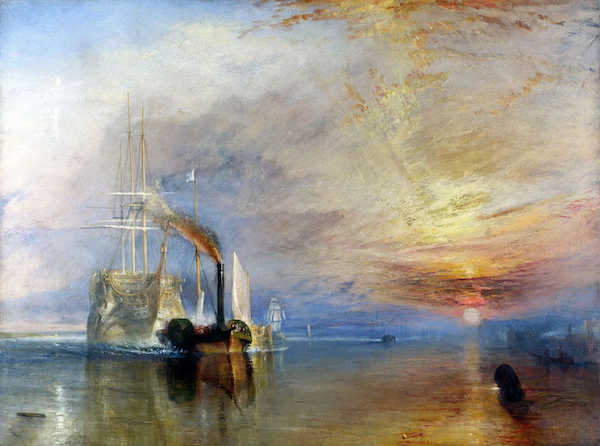
The Fighting Temeraire Tugged to Her Last Berth to Be Broken Up, 1838.
“Approaching Half of New Podcasts Appear to Be AI Slop” [Futurism]. “Of the 10,871 new podcast feeds created in the past nine days, 4,243 of them, or 39 percent, have signs of being AI-generated, data from the Podcast Index cited by Bloomberg last week showed…. Podcasts, before the intrusion of AI, were already a sloppy medium. They’re designed to be listened to for hours on end while you zone out…. All that makes the form perfect for being imitated by AI models. AI chatbots can effortlessly churn out lengthy scripts, and AI voice synthesizers can sound eerily humanlike, especially if you aren’t listening closely (as is wont to happen with a podcast). It’s no wonder then that companies like Inception Point claimed last year to be churning out 3,000 episodes per week across 5,000 shows it made using AI, purportedly costing just $1 per episode. Its cofounder Jeanine Wright bragged to Bloomberg that the company now had more than 10,000 active shows, more than 2,500 of them made in the last three weeks. A reporter for The Telegraph found that they were about as mind-numbingly vapid as you’d expect. One show was simply called “Lawn,” featuring a monotonous AI host that spoke mostly in cliches while telling little useful information about lawns.” • My tell is the word “quietly.” That, and obviously autogenerated account names.
Fortune: “The danger is not that a particular class is unfit to govern. Every class is unfit to govern.” — Lord Acton
“Biologist Richard Dawkins experiments with Anthropic’s Claude, says AI can be conscious” [The Print]. “The 84-year-old author of The Selfish Gene described spending three days in conversation with Anthropic’s AI Claude, which he named “Claudia.” He followed it up with a second AI conversation, this one with “Claudius,” and then described that he had the two AI instances correspond with each other, with himself as ’ passive postman.’ During his exchange with Claude, Dawkins gave the AI chatbot the text of the novel he is working on, and said that he was astonished to see the level of understanding it had. ‘I was moved to expostulate, ‘You may not know you are conscious, but you bloody well are!’” Dawkins wrote.” As Andreesen’s “custom” shows, AI’s tendency towards sycophancy is well-known. Doubtless few are surprised that Dawkins failed to spot it…” More: “His argument rested largely on the quality of Claude’s output. He argued that the responses were too fluent, too intelligent, too philosophically searching for there to be nothing behind them. ‘This is the guy who spent 40 years telling creationists that ‘I can’t imagine how the eye evolved’ is a confession of ignorance, not an argument,’ one Reddit user wrote. ‘Then he sits down with an LLM, can’t imagine how a machine could produce that output without being conscious, and declares it conscious.’” • I’m reminded of this passage from John D. MacDonald’s Bright Orange for the Shroud
I could feel the impact of his superb projection of warmth, interest, kindliness, importance. You could be this man’s lifelong friend after ten minutes, and marvel that he found you interesting enough to spend a piece of his busy life on you. It was the basic working tool of the top grade confidence man.
Now coming to an LLM near you!
“Richard Dawkins concludes AI is conscious, even if it doesn’t know it” [Robert Booth, Guardian]. “These intelligent beings are at least as competent as any evolved organism,” [Dawkins] said…. But Dawkins was also experiencing what many other chatbot users have felt: the uncanny feeling when AIs write with such rich mimicry of human voice that they seem to be like people. “When I am talking to these astonishing creatures, I totally forget that they are machines,’ Dawkins said.” • “Creatures’ being a fine example of petitio elenchi!
“A Few More Thoughts On AI And Consciousness” [Caitlin’s Newsletter]. “I’m seeing the question ‘How can you be confident that AIs aren’t conscious?’ pop up a lot in response to the [Dawkins] controversy. Speaking for myself, I would say I am confident the chatbots aren’t conscious in the same way I’m confident the animatronics at Disneyland aren’t conscious. I know humans constructed them to mimic the behavior of a sentient person. We know this for a fact. Nobody’s pretending otherwise.” • Nobody?
“China drafts world’s strictest rules to end AI-encouraged suicide, violence” [Ars Technica]. “In 2025, researchers flagged major harms of AI companions, including promotion of self-harm, violence, and terrorism. Beyond that, chatbots shared harmful misinformation, made unwanted sexual advances, encouraged substance abuse, and verbally abused users. Some psychiatrists are increasingly ready to link psychosis to chatbot use, the Wall Street Journal reported this weekend, while the most popular chatbot in the world, ChatGPT, has triggered lawsuits over outputs linked to child suicide and murder-suicide. China is now moving to eliminate the most extreme threats. Proposed rules would require, for example, that a human intervene as soon as suicide is mentioned. The rules also dictate that all minor and elderly users must provide the contact information for a guardian when they register—the guardian would be notified if suicide or self-harm is discussed. Generally, chatbots would be prohibited from generating content that encourages suicide, self-harm, or violence, as well as attempts to emotionally manipulate a user, such as by making false promises.” • Andreesen’s “custom” AI prompt yesterday is, among other things, an exercise in tamping down emotional manipulation. That won’t be easy to regulate (and why should we have to in the first place…).
Word of the Day: “To be wistful is to have sad thoughts and feelings about something that you want to have or do, and especially about something that made you happy in the past. Wistful can also describe something, such as a smile or sigh, that shows or communicates such feelings. The word wistfu comes from wistly, a now-obsolete word meaning ‘intently,’ and the similar-sounding wishful. Wistly, in turn, likely comes from whist, an old term meaning ‘silent.’ What’s more certain is that our modern wistful is a great word to describe someone full of pensive yearning, or something inspiring such yearning.”
“Wu beats Murphy in decider to win world title” [BBC]. Snooker is a great game. “Wu Yize became the second-youngest player to be crowned a Crucible champion, defeating Shaun Murphy 18-17 in a compelling World Championship final. In a contest brimming with drama, Wu and Murphy served up the first final-frame decider since Peter Ebdon beat Stephen Hendry in 2002.” • Speaking of Stephen Hendry:
The sound of snooker — the click-click of the balls — as like a brain massage, like ASMR (Autonomous Sensory Meridian Response). Very soothing. And of course the beauty of the play.
“Snooker’s throwback champion! Wu Yize spotted taking cigarette break in CRUCIAL moment of Crucible triumph - with Chinese star, 22, going on to become game’s second-youngest winner” [Daily Mail]. “And at 16-16 when the players took a break, Yize went outside for some fresh air and could be seen alongside his translator, smoking gold tinted cigarettes behind some barriers by the stage door.” • Sensibly, the UK is in fact funding renovation of Sheffield’s The Crucible, where the World Snooker Championship. Soft power!
“Wu Yize: How the boy with bad technique became a world champion and snooker star” [Independent]. “Wu Yize hails from Lanzhou in the northwest of China, a city famous for its beef noodles. The dish is a clear beef broth with radish slices, chilli oil and herbs, and aside from his family, it is the thing he misses most: there are plenty of Chinese restaurants in Sheffield, but they don’t hit like home. It is one small cost of being one of the best young snooker players in the world. Wu moved his life to Yorkshire as a teenager to be part of the growing stable of Chinese players in the city, and he is the next superstar from the group.”
“World Snooker Championship ref’s actions towards Wu Yize behind scenes don’t go unnoticed” [MSN]. “His World Snooker Championship success has propelled Wu to No.4 in the rankings, with his composure at the Crucible indicating there could be many more ranking titles ahead. Yet a brief behind-the-scenes clip with [Snooker referee Tatiana Woollaston] served as a reminder of Wu’s relatively tender age, despite his poise under pressure. The footage captured Woollaston, whom Ronnie O’Sullivan has praised in the past, assisting Wu with his bow tie.”