
Patient readers, this Water Cooler posted prematurely. I’m still trying to master the interaction between revisions and our scheduler. —lambert
‘
Birdsong of the Day
Gray Catbird:
With a summer insect in the background, I think.
In Case You Might Miss…
(1) Donald Knuth on AI.
(2) Hanta virus.
Politics
Trump Administration
“Trump administration considers mandatory pre-release vetting of AI models — Anthropic’s Mythos cited as catalyst for policy reversal” [Tom’s Hardware]. “The Trump administration is said to be discussing an executive order that would establish a government review process for new AI models before they’re released to the public, The New York Times has reported, citing unnamed U.S. officials…. The proposed order would create an ‘AI working group’ of tech executives and government officials to develop oversight procedures, with White House staff briefing leaders from Anthropic, Google, and OpenAI on the plans last week. These discussions, if true, would represent a sharp departure from the administration’s current stance as something of a deregulatory champion…. The sudden reversal coincides with a leadership vacuum in White House AI policy. David Sacks, who led the administration’s deregulation push as AI czar, left the role in March, with White House Chief of Staff Susie Wiles and Treasury Secretary Scott Bessent having since taken a more active role in shaping AI policy.” • So, a magic board with industry members. Let me know how that works out.
“Trump administration considering safety review for new AI models” [Axios]. “In a post-Mythos world, the Trump administration appears to be reevaluating its hard line against the AI safety and security measures it once shrugged off…. While Trump immediately revoked the Biden administration’s AI executive order on Day 1, many of the ideas that are now being considered already existed in that order…. Economic and tech policy voices are worried about any policy changes that could complicate deployments [rent-seeking], while the national security community is worried about the possible of a major AI-enabled cyberattack.”
“Senators seek Labor-led database on AI workforce impacts” [FedScoop]. “The Workforce Transparency Act (S.4476) from Sens. Mark Warner, D-Va., and Ted Budd, R-N.C., continues a trend from lawmakers and agency leaders aiming to gather more information on artificial intelligence and make it readily available to researchers, businesses and governments. ‘As AI is being developed, deployed, and integrated across industries, we’re already seeing it have a measurable effect on the U.S. workforce, and we know that its impact is only going to grow,’ Warner said in a press release. ‘It’s critical that everyone has access to accurate and timely information that can prepare them for a changing labor market.’” • Remember “learn to code”? That certainly prepared us for “a changing labor market”!
* * * “FAS 2.0 becomes ASD/Create: GSA’s quiet rewiring of federal procurement power”[Federal News Network]. “By any outward measure, the General Services Administration’s Federal Acquisition Service has long been the government’s workhorse — running schedules, managing contracts and keeping the machinery of procurement moving. But the newly announced “FAS 2.0” reorganization, apparently to be rolled out the week of May 4, signals something more ambitious: A deliberate shift from contract administration to centralized, portfolio-level control over how the federal government buys technology. This is not a reshuffle. It is a redefinition of mission. This consolidation reflects a clear philosophical shift. FAS 2.0, which will now be called Acquisition Solutions Development/Create, is no longer positioning itself as a neutral marketplace facilitator. It is becoming a strategic buyer, with the authority — and increasingly, the data — to shape demand, standardize terms and influence pricing across the federal enterprise.” • I am sure there are readers who know more about government contracting than I do, but this actually seems sensible to me. Unless it’s cover for political appointees to make anyone and everyone Palantir subcontractors, of coruse.
* * * “Unstitching America” [Benjamin Fong, Phenomenal World]. ” In February 2025, Wells Fargo’s Equity Research team, an arm of its investment banking business, answered the call by publishing a “framework” for postal privatization, further whetting the private sector’s appetite…. What would privatization entail? Will the current struggles of rising energy costs, imperilled congressional appropriations, continued growth of private competition, and decreasing revenue from Amazon give such machinations new life? For postal privatization to proceed, there would need to be congressional action to overturn the Postal Reorganization Act of 1970 (which established USPS in its current form), a vote that would no doubt make legislators on both sides of the aisle queasy. While this does not seem like an imminent possibility, just months after Wells Fargo published its privatization framework, the USPS Board of Governors elected David Steiner, a member of the FedEx board of directors, as Postmaster General. By 2028, all eight of the members of USPS’s Board of Governors will be Trump appointees.” But: “USPS operates under what’s called a Universal Service Obligation (USO) to deliver mail to every address in the US, six days a week—”from remote Alaskan communities to the bottom of the Grand Canyon,” in the words of David Yao, Vice President of the Greater Seattle Area Local of the American Postal Workers Union (APWU). Such concepts of “universal service” are as old as regulated monopolies themselves on both sides of the North Atlantic, and since USPS became an independent government corporation in 1971 it has been under one. This commitment is not simply an “inefficiency” that any private company would rationalize. It is also something that is logistically impossible for any private corporation to fulfill. Take a sparsely-populated state like Wyoming. By my current count, UPS has nine last-mile delivery facilities, i.e., buildings from which delivery drivers pick up their loads for the day and set off to deliver packages; FedEx has eight, and Amazon two. USPS, by contrast, has seventy-seven. The last-mile facilities for these private companies are perfectly adequate for the purpose of package delivery (especially if they can send anything they don’t want to deal with to USPS), but to actually deliver on the USO, they would need an order of magnitude more in terms of last-mile capacity—both additional buildings as well as more carriers to drive and walk regular routes.” • Well worth a read, as bankster greedheads attempt to destroy yet another national treasure.
* * * “Trump’s ‘alien files’ could shatter Christian beliefs, churches should prepare for it, claim pastors” [Firstpost]. “A group of popular American pastors have warned that President Donald Trump’s release of ‘alien files’ could shatter Christian beliefs… They have claimed that US intelligence officials have held a series of meetings with them and told them to prepare churches to hold the Christian community together in the wake of the revelations’ shockwaves. Popular evangelist pastor Perry Stone said that the alien files could include reports and possibly videos of aliens and extraterrestrial spacecraft. ‘You’re going to have people who are going to say if there are galaxies and there are allegedly other creations in the galaxies, then the whole creation story is a myth, and you’re going to have people that’s going to apostatise and turn from the Christian faith because they have no answer for what they’re about to hear,’ said Stone.” • I’m not seeing a problem, here.
“The search for aliens levels up” [Astronomy]. “[A]fter a century of listening, we are still alone in the vast cosmos — though that has not killed the hope that radio telescopes could open a line of communication to alien civilizations. … The coming decade will see the biggest jump in search capabilities since the field began, raking in unprecedented torrents of data — a welcome development for astronomers. If we want to understand why we haven’t found anything, ‘we need to do more of everything — expanded frequency ranges, broader sky coverage, more frequent and detailed observations,’ said Steve Croft, an astronomer at the SETI (Search for Extraterrestrial Intelligence) Institute and the University of California, Berkeley. ‘We haven’t looked well enough yet to say much so far.’” And: “If we’re not alone, might that encourage us to shape up, draw together as one human species, and put our best foot forward for our galactic debutante ball? And if we are alone, shouldn’t that make us value our planet more than ever? Could we really risk extinguishing all the life that has ever existed in the galaxy as a result of mindless wars and small-minded contentions? Perhaps we’ll find that if and when we shape up, then our cosmic neighbors will come knocking.” • Debutantes, neighbors…. “The thing about aliens is that they’re alien” (I think from a Greg Bear novel).
Democrats en Déshabillé
“The Idea That Reshaped Identity Politics Has a Complicated Backstory” [Kelefa Sanneh, The New Yorker]. “By 2011, “intersectionality” had nearly completed its journey from intellectual obscurity to cultural ubiquity. In an era of social-media politics, with everyone talking to (or shouting at) everyone else, arguments and identities tended to stack atop one another, and so ‘intersectionality” made intuitive sense: it explained why movements needed to be accountable to multiple constituencies at once.” Guaranteeing failure. “Intersectionality” was born in 1989, in a law-review article titled ‘Demarginalizing the Intersection of Race and Sex: A Black Feminist Critique of Antidiscrimination Doctrine, Feminist Theory and Antiracist Politics.’ The author, a professor named Kimberlé Williams Crenshaw, proved to have a knack not just for provocative legal essays but for coinages, too.” And: “In all these instances, Crenshaw seemed to be taking her own advice and paying heed to the perspectives of the “most disadvantaged.” But, as the intersecting identities become more complicated, “most” can be hard to define.” • That’s not a bug. It’s a feature. The social function of the Democrat Party is to keep the working class divided, demoralized, and disempowered. In this it has succeeded brilliantly, and Crenshaw should feel able to take full credit.
Protest
“Weapons of the Meek” [n+1]. “The weapons workers were guarded almost as fiercely as the ammo they made. The simple geography of the plant — a three-hundred-thousand-square-foot complex with a gated employee lot and only two exits — seemed designed to thwart us. We had imagined we would approach workers as they walked to their cars, but we now saw that doing so would require braving an enclosed lot ringed with no trespassing signs. In the howling wind, we debated our next move.” • “Seemed”?
“ ‘No One Talked.’ On Growing Up Under Brazil’s Military Dictatorship” [Literary Hub]. “We weren’t a particularly political family, but my father knew what was going on, and sometimes he’d make comment about a body being found under a bridge, the government going too far. My mother would shush him and change the subject. She didn’t trust the silence of our walls. This atmosphere of secrecy extended into personal matters too. I had a disabled twin sister, and one day when I was nine years old, I woke up and she was gone. My parents had sent her away, to live in an institution. There were other secrets too. After we moved from rural Brazil to Rio, our life changed dramatically. My father had a fancy new job, and with it came parties and British expats and tennis clubs. My mother’s illiteracy was kept secret, as was my father’s lack of education (he didn’t finish high school). There was a tone, a quietness and a particular register of voice that I learned to listen for as a child. It meant they were talking about something forbidden: often, my twin sister’s illness, or later, her institutionalization. It was the same tone when they talked about the government. A journalist my father knew had been killed. The newspaper said it was suicide, by my father knew better. I would strain to hear these snippets, afraid that some other unannounced calamity might ensue.”
#COVID19
Stay safe out there!
Transmission
“National COVID-19 trends, May 5” [The Sick Times]. “A historic COVID-19 lull in the U.S. has continued through late April. Disease levels in wastewater and as measured by the healthcare system are at their lowest in several years; I’m surprised to see this considering the continued lack of widespread health measures. BA.3.2 (or “Cicada”) remains on the horizon but doesn’t appear to be having a widespread impact yet. Both the CDC and WastewaterSCAN report lower levels of SARS-CoV-2 in wastewater and either plateaus or declines, both in their national averages and across all regions.” • Long may this continue.
The 420
“Beyond a Theory of Irresistible Desire” [Los Angeles Review of Books]. “I first met Hanna [Pickard], who is now a professor of philosophy at Johns Hopkins University, when she was a visiting professor and I a postdoctoral researcher at Princeton in 2017. She gave a talk that flipped the study of addiction on its head. Instead of asking why “those people’ use drugs, she asked ‘Why are we not all using drugs, all the time?’” • That’s a very good question. And of course, some of “us” are! “We were somewhere around Barstow, on the edge of the desert, when the drugs began to take hold”:
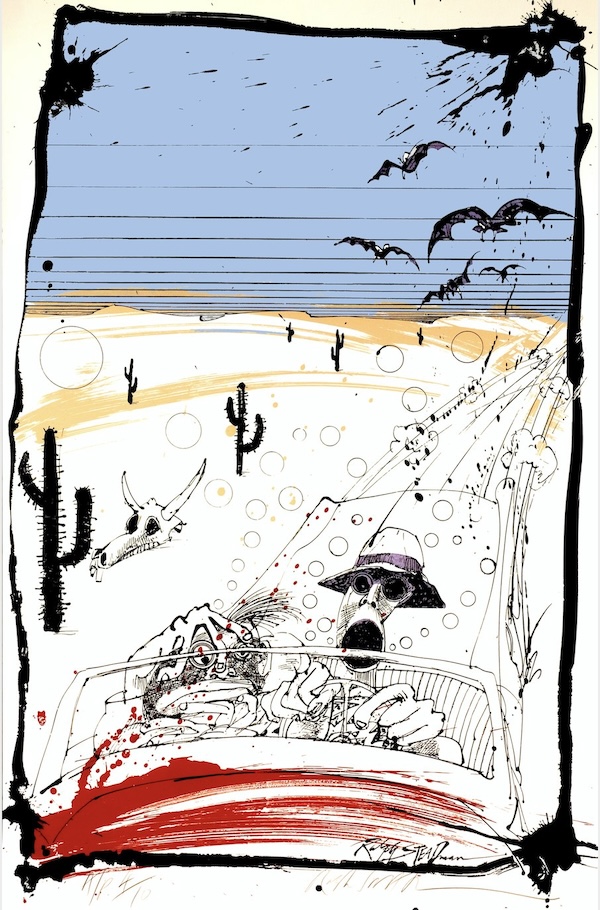
I’m picturing Steadman’s image with the Thompson’s face replaced by Trump’s: “We were somewhere around Isfahan, on the edge of the desert….”
“US FDA plans ultra-fast review of 3 psychedelic drugs after Trump directive” [South China Morning Post]. “The FDA said it awarded priority review vouchers to two companies studying psilocybin – the active ingredient in magic mushrooms – for hard-to-treat forms of depression. A third company received a voucher for methylene, a drug related to MDMA, for post-traumatic stress disorder. The FDA did not name the companies in a press release announcing the vouchers…. The recent moves on psychedelics reflect growing popular support for the mind-altering substances among Trump’s supporters, including combat veterans and followers of the Make America Healthy Again movement spearheaded by Health Secretary Robert F. Kennedy Jnr.” • Beyond the obvious jokes, I’m having a hard time categorizing this “growing popular support.” Are Trump supporters former hippies?
“Trump administration move to reclassify cannabis sparks confusion” [Guardian]. “The Trump administration is making good on its promise to reschedule cannabis, but only partially – raising plenty of questions for those in the cannabis industry. Todd Blanche, the acting attorney general, signed an order last week that removes products sold under state medical cannabis licenses and FDA-approved cannabis products from schedule I – defined as substances with no accepted medical use, to schedule III – which includes legal but regulated substances including certain doses of Tylenol with codeine and ketamine. ‘While some marijuana-related products are no longer being treated as schedule I, it’s not accurate to say marijuana has been broadly rescheduled – this is partial rescheduling, at best,’ said Cat Packer, director of drug markets and legal regulation at the Drug Policy Alliance…. The order justifies the partial move by repeatedly citing the Single Convention on Narcotic Drugs, a UN treaty that 73 nations including the United States entered in 1961. The convention requires that specified ‘narcotics’, including cannabis, be produced only in limited quantities, and for scientific and medical purposes only.” • Citing to a UN treaty? Certainly a first for the Trump Administration!
“Why America is falling out of love with cocaine” [Straight Arrow News]. “[T]he data reveals that, unlike most of the world, where cocaine use is on the rise, the drug is actually losing traction in the U.S…. Almost 6 million people (5.9 million) in the U.S. admitted to prior-year use of cocaine in 2017, according to the annual National Survey on Drug Use and Health. By 2024, this number had fallen to 4.3 million. Among 18-25 year olds, the drop over these 7 years has been steeper, from 2.1 million to 811,000 — a trend reflected in a fall since 2017 in the number of people aged under 30 admitted into treatment for cocaine addiction.” And: “One driver for the downturn is fear. People are more scared of taking cocaine than they have ever been before because of the much-repeated story the drug is being intentionally laced or contaminated with fentanyl, a highly potent opioid designated a Weapon of Mass Destruction by the White House in 2025. Over and above cocaine’s well-known risk of causing heart problems, fear of fentanyl in cocaine has become a mounting concern that, due to both the nature of the U.S. drug trade as well as public health messaging, has remained largely unique to North America.” And: “As the cost of living has hit harder over the last decade, cocaine’s relatively high price compared with similar drugs — around four times that of meth and double that of ketamine — is prohibitive to some. ‘There is a good reason for cocaine use to be flat or down: meth use is on the rise and spreading geographically. It is not a pure competitor, but it will compete for some of the population. And this meth is cheap and super strong,’ said Ciccarone. Cocaine use has also been impacted by the shifting sands of American culture, as new generations ditch the drugs used by their parents. For some, it’s a drug that no longer suits their lifestyle or their ethics. Cocaine has always been heavily associated with alcohol, and the two drugs spur each other on: cocaine enables longer drinking sessions and alcohol increases risky behavior. American alcohol use is now at a record low. This decline is much more pronounced in the U.S. than in Europe, and especially among young Americans, who are also less likely than before to go out to bars and clubs.” • A crisis in affordability, then.
“Turn on, tune in, cash out … The US right used to fear psychedelics. Now it wants to sell them” [Guardian]. “Earlier this month, almost exactly 60 years after this tense inquiry, Ted Kennedy’s nephew Robert F Kennedy Jr stood behind Donald Trump as he signed a new presidential executive order to accelerate mainstream access to medical treatment based on psychedelic drugs. A particular focus is ibogaine, a psychoactive compound derived from a West African shrub, which scientists suggest can be effective for treating chronic mental-health problems. Kennedy Jr has been the champion of psychedelics within the Maga coalition, alongside figures such as the podcaster Joe Rogan, who stood beside him in the Oval Office on 18 April.” And: “Long caricatured as a marker of countercultural decadence, psychedelics have been rebranded by recent clinical research as potentially transformative mental-health treatments, helping patients suffering with issues such as depression, PTSD and suicidal ideation, and attracting unexpected new supporters. In 2023 Rick Perry, the former ultra-conservative governor of Texas turned psychedelics evangelist, argued that when it comes to legalisation of psychedelics, ‘at the federal level, this is more supported by the Republicans’ than the Democrats.” • Republican psychedelics evangelists… It’s a funny old world.
Book Nook
“The Dark Real-Life Inspirations Behind ‘Lord of the Flies’ ” [Mental Floss]. “[William Golding] and his wife Ann often read stories to their young children. One of these stories was the 1857 adventure novel The Coral Island, which depicts how a group of children stranded on an island survive thanks to Christian values and British cultural norms. One night, Golding joked that it would be a good idea to write a story that portrayed how kids would really act if left alone on an island. His wife encouraged him, and Lord of the Flies was born… After the war, Golding was left with a new understanding of the extent of human brutality. ‘It was simply what seemed sensible for me to write after the war when everyone was thanking God they weren’t Nazis. I’d seen enough to realize that every single one of us could be Nazis,’ Golding said of how what he witnessed during the war inspired him to write Lord of the Flies…. Lord of the Flies also emerged in the wake of the bombing of Hiroshima and Nagasaki…. The boys are on the plane at the beginning of the novel because they’re fleeing a nuclear disaster, and literary critics have connected the numerous fires that explode across the island in the novel to the specter of the atomic bomb.” But:
“Inside the Lord of the Flies Survival of 6 Tongan Boys 54 Years Ago: ‘The Story We Need Now’ ” [People (2020)]. “Unlike in that classic novel, which is the story of boys on a deserted island turning on each other, Sione and his friends made a pact that first day to live on the island just as they had been raised in their respective families scattered across the small islands of Tonga. ‘We all come from close and poor families where, whatever you get, you share,’ says Sione, describing a detailed system the boys worked out for growing food, tending a permanent fire (the flame never went out over 15 months), exercising and resolving arguments. Nights around the fire were for airing grievances. ‘If anybody had something they didn’t like, they talked about it and we say ‘Sorry’ and then pray and everything’s okay,’ recalls Sione, one of the two eldest boys, who took on a leadership role. ‘If someone got really mad — like, if I planned something and they didn’t do it — you disappear for a few hours, look at the ocean and clear it out of your mind.’” • Perhaps British schoolboys aren’t the best choice to represent humanity? More here.
Class Warfare
“Bard President Leon Botstein (Finally) Retires, Following Epstein Revelations” [ARTnews]. “Leon Botstein, who has led Bard College since 1975 and shaped it into one of the art world’s most influential liberal arts institutions, announced Friday that he will retire, after an independent report found he had not been “fully accurate” in his public accounts of his relationship with convicted sex offender Jeffrey Epstein, the New York Times reported…. Botstein’s retirement is a consequential moment for the art world: Bard is home to the Center for Curatorial Studies (CCS), one of the most prominent graduate programs in curatorial practice in the United States, and its affiliated CCS Hessel Museum of Art. Botstein’s five-decade tenure had made the school a fixture in art-world institutional life. Documents released by the Department of Justice earlier this year showed Botstein’s name appearing more than 2,800 times in Epstein-related files, including emails that indicated a warmer relationship than Botstein had previously acknowledged. In a 2013 note, Botstein signed off with ‘Miss you’ and described his ‘new friendship’ with the financier, and expressed goodwill toward Epstein following news coverage of Epstein’s abuse. The WilmerHale review [initiated by Board of Trustees chair billionaire James Cox Chambers] also found that Botstein had visited Epstein’s private island, invited Epstein to Bard’s campus and to a Bard-affiliated high school.” • And: “In 2004, Chambers married Nabila Khashoggi, daughter of billionaire Adnan Khashoggi.” But: “Epstein had been hired by the ultra-rich businessman Adnan Khashoggi from the Kingdom of Saudi Arabia.” So, James Cox Chambers -> Nabila Khashoggi -> Adnan Khashoggi -> Jeffrey Epstein. Three degrees of separation in the billionaire class, just like I said.
“Urban Truth Collective: The One-Hour City Conspiracy” [StreetsBlog]. “At the same time, driving commute times have passed the one-hour mark, meaning that many people are trapped for hours each day in their cars. Too many of us, and more every day, live in these kinds of places. The one-hour city probably does not involve a bunch of evil men in suits conspiring around a big, sinister table. Short of audio-video footage of said meetings, or extensive documentation, we’ll never know for sure. But we do know from extensive evidence that there is a collection of aligned interests that make a lot of money from people driving more. These actors have lobbied for laws that make it harder to get to shops, businesses, schools, restaurants, and government and medical services near to where people live.”
“Forced Labor-Made Goods Are Illegal In Canada, And That Might Be A Problem For U.S. Car Manufacturers” [Jalopnik]. “Canada takes forced labor very seriously, going so far as to rigorously ban products from China that might have been made by folks under duress. That law, the Supply Chains Act, was written to target Chinese human right’s abuses, but it applies just as much to American products, Canadian human rights lawyers say…. A whole lot of stuff is made in the U.S. under what could conceivably be called slave labor. Everything from playground equipment to fruits and vegetables could be produced under coercion, as the U.S. constitution does not ban slavery for incarcerated people. Funnily enough, parole rates are dropping fast in Alabama, a state with one of the highest incarceration rates in the nation.” • Leading to power relations like this:
News of the Wired
Plant of the Day
Via JB:
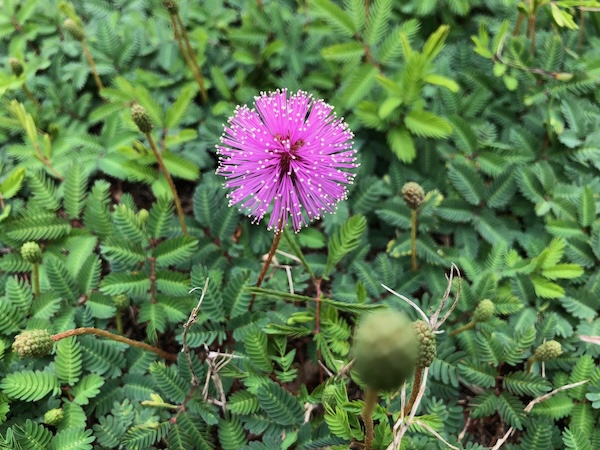
JB writes:
And in closing, this last thing; allow me to share a photo. It’s a bloom of Mimosa pudica, the sleeping plant which i took with my ancient iPhone. Sensitive to touch, which leads it to close its leaves temporarily, it’s a creeping annual of the legume family Fabaceae. And one, which is slowly taking over my yard. What’s more, I love it as a ground cover far more than I like grass (by a country mile).
Dear readers, I am running short of Plantidotes!Send your plantidotes as attachments to lambert [UNDERSCORE] strether [AT] protonmail [DOT] com. And if you put “Plant” or “Plantidote” in the subject line, I’ll be less likely to lose it. Gardening season approaches, at least in the Northeast. Prep work is fine!
Comments
Send me one or two, and perhaps that will remind me of my level of frustration! I do try, on principle, not to let photographic quality be a bar, although of course it’s good to have it; the plant is the focus.
Whilst I authored these two articles for the benefit of my model aircraft customers, the principles within them (and they’re totally free, you don’t even need to sign up) remain perfectly germane to photographing plants, so I’ll share.
Anyway, with a bit of practice you can easily freehand the photos (hand holding whilst framing and snapping the shutter button). However, an mobile phone type tripods are readily available, and inexpensive.
This link is to a decent mobile phone table-top type tripod. Using this will pay dividends with close up photos(ones, which are close to the ground as was the mimosa pudica photo, above).
Anyway, the perennial battle of the tripods is the tradeoff of mass vs rigidity. The one I shared in the above link is good for low and close to the ground but totally useless for something at eye level. Fortunately, for mobile phones, because they are relatively low mass items, a flimsy tripod is often just fine (I use Sachtler tripods for professional work, and even then I have to be careful in regards to the mass of what I’m mounting on the fluid head and regarding if it’s a static shot, or one incorporating movement … but this is taking us into the weeds we aren’t even taking photos of).
Good luck, and remember, you’re no longer paying for developing the film, so take a butt load of photos and be ruthless with culling. Then send Lambert only the one you like (don’t make him select between two photos ‘you’ do that.
—
Cheers,
I highly recommend clicking the MORE HERE, a Book Review of HUMANKIND which starts with LoF, then covers the Kitty Genovese murder, the Milgram experiments and much else. My favorite bit is that through history, the majority of military gunfire is over the head of the enemy. We ain’t what we’ve been made out to be!
Given the number of people out on the streets using drugs, perhaps the decline is due to the fact that cocaine would blow away a lot easier than other narcotics. This does not seem to be a problem with opioids — why just the other day I walked past one guy with a bloody needle jabbed into his forearm and another smoking what was likely heroin, given that he was out cold in a heap on the sidewalk about five minutes later. Did I mention there’s a YUGE drug problem in my city?
Plantidotes