
As their initiatives have hollowed out the IRS workforce, Elon Musk’s Department of Government Efficiency (DOGE) has moved rapidly and secretively to consolidate control over the immense stores of personal data housed within the IRS, undermining long-standing legal protections for taxpayers’ privacy. This accrual of surveillance and policing power threatens Americans’ civil, political, and economic liberties.
In mid-February, DOGE sought access to the IRS’s Integrated Data Retrieval System (IDRS), which includes names, addresses, ID numbers, and bank information for U.S. tax filers. These demands were the equivalent, according to former IRS Commissioner Danny Werfel, of a newly hired custodian at a bank demanding “the key to every safe deposit box in the vault.” Given the highly sensitive nature of the data, this system is strictly limited to those for whom access is job-essential and—unlike the Treasury payments system operated by the Bureau of the Fiscal Service, to which DOGE at one point had read-write access—DOGE’s IDRS access was limited to anonymized data.
Over the following weeks, however, DOGE continued to push for greater access to IRS systems, at one point seeking personally identifiable tax information to investigate student loan and SNAP recipients. In March, the agency announced that 48 of the IRS’s senior information technology executives would be put on leave. Then, in early April, it was reported that DOGE was holding a “hackathon” at the IRS to kick off a month-long project to build a “mega API” that would allow for easier data exchange between agencies. It is not entirely clear who participated in this “very unstructured” endeavor to rewrite the systems that contain and protect Americans’ tax data. “It’s basically an open door controlled by Musk for all Americans’ most sensitive information with none of the rules that normally secure that data,” one IRS employee told Wired. Records from the IRS and the Social Security Administration are reportedly being combined with biometric data and information from some state voter files in a central repository housed within U.S. Customs and Immigration.
These events would be worrying under any circumstance but are especially so in the context of mistakes at the IRS and reports of data abuse at other agencies. In the lead-up to Tax Day, the IRS website displayed a multitude of errors, which had appeared soon after DOGE publicly celebrated making revisions to the site. At the Social Security Administration, DOGE affiliates demanded that thousands of living immigrants be added to the “death master file” and surreptitiously extracted potentially sensitive data from the National Labor Relations Board. At least seven lawsuits have been filed regarding the access of DOGE to the American public’s personally identifiable data at Treasury and at other agencies.
Section 6103 of the Internal Revenue Code tightly defines the contexts in which individuals’ IRS data can be disclosed or even inspected. Section 6103 allows the IRS to share tax information with law enforcement agencies for “investigation and prosecution of non-tax criminal laws,” but many immigration violations are civil offenses, not criminal ones. … Nonetheless, Immigration and Customs Enforcement and the IRS entered into a memorandum of understanding (MOU) in early April…. The signing of the MOU provoked the resignation of acting IRS Commissioner Melanie Krause, the third commissioner to resign since January. This and other high-level departures linked to the Trump administration’s data-sharing demands indicate the seriousness of the privacy issues involved. They also mean that the implementation of the MOU will likely not receive appropriate levels of oversight. A
Figure 1 summarizes the loss of agency leadership between Jan. 20 and April 19:
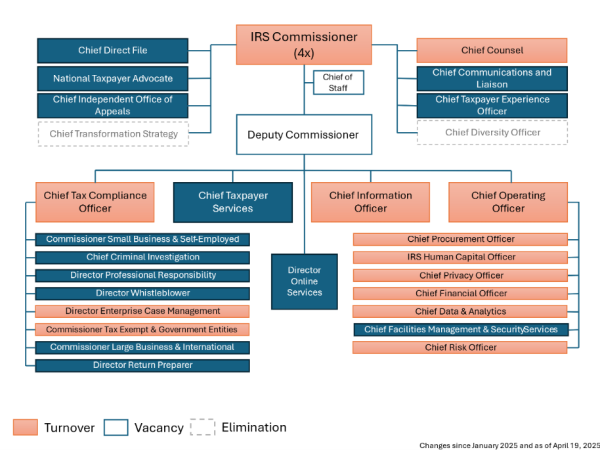
The trend is clear: the decline of independent civil service and the rise of partisan loyalism at the top of the tax agency. Increasing the political control of the IRS was an explicit goal of the Heritage Foundation’s presidential transition playbook known as “Project 2025,” which called for a drastic increase in presidential appointees at the IRS, including appointees “not subject to Senate confirmation.” The politicization of the tax agency will likely accelerate with the recent revival of “Schedule F,” a regulatory change first proposed at the end of the first Trump administration that would remove civil service protections from about 50,000 federal employees.
Nixon’s efforts to pressure the IRS featured prominently in the case for his impeachment. The articles adopted by the House Judiciary Committee in July 1974 refer to both seeking “confidential information contained in income tax returns for purposes not authorized by law” and causing “income tax audits or other income tax investigations to be initiated or conducted in a discriminatory manner.”
The Trump administration’s actions are, as former IRS Commissioner John Koskinen has said, “moving back toward the Nixon ‘enemies list’.” They are also a move toward the kind of tax enforcement found in contemporary autocratic regimes like Hungary and Turkey: intended to chill dissent and undermine opposition. Those audits do not need to find wrongdoing to be successful. “It’s more about keeping us busy rather than shutting us down,” as one Hungarian anti-corruption activist put it.
Americans have traditionally had exceptionally high “tax morale” by international standards: Despite our annual grumbling, there is a strong and long-standing popular commitment in the United States to the civic responsibility of taxpaying. But if it becomes clear that taxpaying by the wealthy has become functionally optional, it will erode mass tax compliance. The widespread perception (or reality) that taxpayers’ data is being misused could also do untold damage. These effects are unlikely to be linear, but it is very difficult to predict the tipping point from a norm of compliance to a norm of evasion.
Taxation and representation are not just linked in a slogan; they develop together. When people see their government as legitimate and have a say in how public money is raised and spent, they are more willing to contribute. The need for tax revenue also encourages governments to be responsive to the citizenry. Thus the highest-tax countries in the world also rank at the top of global democracy indices. Autocracies have less effective tax regimes, in part because their residents have lower tax morale. But autocrats also do not want an effective tax system, because taxation provokes demands for representation. They prefer to rely on tributes, and on the fees and fines they can extract from a corrupted justice system.
It is too early to judge how, or whether, the United States will reverse its current autocratic trajectory. But we should recognize that the lurch toward a personalist, strongman government is reinforced by the destruction of an independent civil service, and particularly the destruction of the independent, nonpartisan tax service.
The revenue raised by the IRS is a prerequisite for all federal action.
Lambert here: Except that Federal taxes do not fund Federal spending. It would be nice to hear an MMTer expound on the effects of a massive drop in compliance.