
Patient readers, I apologize for the late posting. I was so caught up in the flow I lost track of time! —lambert
Birdsong of the Day
Moar mimidae:
Rang 3 Notre-Dame-des-Neiges, Les Basques, Quebec, Canada
In Case You Might Miss…
(1) Google’s AI View censors Gibson’s Neuromancer.
(3) “Will 2026 Be a Normal Midterm?”
(4) “AI companies are gaining access to exceptionally intimate data about consumers.”
Politics
Trump Administration
“NASA unveils sweeping reorganization” [Space.com]. “NASA announced one of its biggest reorganizations in recent memory May 22, combining mission directorates and reshuffling personnel…. The biggest changes involve the agency’s mission directorates. NASA is combining its Exploration Systems Development Mission Directorate (ESDMD) and Space Operations Mission Directorate (SOMD), creating the Human Spaceflight Mission Directorate, or HSMD. The merger effectively recreates the Human Exploration and Operations Mission Directorate that NASA had for a decade before it was split into ESDMD and SOMD in 2021.” And: “The reorganization creates three program manager positions within HSMD. Dana Weigel will be program manager for low Earth orbit, including the International Space Station and Commercial LEO Destinations. Jeremy Parsons will be program manager for Artemis, while Carlos García-Galán will be program manager for the new Moon Base initiative.” • Nothing about Mars?
“Lawmakers Demand Answers as CISA Tries to Contain Data Leak” [Krebs on Security]. “On May 18, KrebsOnSecurity reported that a CISA contractor with administrative access to the agency’s code development platform had created a public GitHub profile called ‘Private-CISA’ that included plaintext credentials to dozens of internal CISA systems. Experts who reviewed the exposed secrets said the commit logs for the code repository showed the CISA contractor disabled GitHub’s built-in protection against publishing sensitive credentials in public repos. CISA acknowledged the leak but has not responded to questions about the duration of the data exposure. However, experts who reviewed the now-defunct Private-CISA archive said it was originally created in November 2025, and that it exhibits a pattern consistent with an individual operator using the repository as a working scratchpad or synchronization mechanism rather than a curated project repository. In a written statement, CISA said ‘there is no indication that any sensitive data was compromised as a result of the incident.’ But in a May 19 a letter (PDF) to CISA’s Acting Director Nick Andersen, Sen. Maggie Hassan (D-NH) said the credential leak raises serious questions about how such a security lapse could occur at the very agency charged with helping to prevent cyber breaches.” • “Private-CISA,” I love it. I wonder if there’s a profile called “Stolen-IRS”?
Election 2026
“Maine US Senate candidate Graham Platner ad criticizing Boston Red Sox pulled during game” [Boston Herald]. “Maine U.S. Senate candidate Graham Platner says a campaign ad that says private equity has destroyed the Boston Red Sox was removed by the station during Friday’s game — which the Sox lost. ‘Yesterday we started running this ad during the Red Sox game,’ the campaign account for Democrat Graham Platner posted on X on Saturday. ‘Midway through the game the ad was taken down by the station (which is owned by Red Sox ownership). And then the Sox blew a 4–0 lead,’ the post added.” • Ouch!
“A Democrat Took on Red Sox Ownership in an Ad. A Network Pulled it” [New York Times]. “New England Sports Network, which is owned by the Red Sox and the Boston Bruins professional hockey team, confirmed the removal of the commercial. ‘NESN removes advertisements when credible concerns arise regarding the use of intellectual property,’ the network said in a statement Saturday. ‘The advertisement in question was removed because the creative included unauthorized use of third-party intellectual property and did not comply with NESN’s advertising standards.’ The network did not directly address a follow-up inquiry about what specific intellectual property it was referring to. A spokesperson for the Red Sox did not have any immediate comment.” • LOL, no.
“I’m a Maine reporter who went to high school with Graham Platner. Here’s what explains his success” [The Maine Monitor]. “I don’t recall the issues they discussed, but I do remember Platner proposing collective action to overturn some school policy — saying something along the lines of, ‘They can’t suspend us all.’; The history teacher serving as moderator interjected to remind Platner and everyone else that, yes, in fact, they could. Students elected the safe candidate, a future chiropractor. But Platner had other outlets for his energy and ideas. Around that time, he skipped school to protest the coming Iraq war when President George W. Bush visited our local airport — and was forcibly removed by the Secret Service. In the high school yearbook, our class voted him ‘most likely to start a revolution.’” More: “This race has become perhaps the country’s clearest referendum on how Democrats should be responding to Trumpism…. He has held more than 50 town halls — so well attended that people are often turned away — and shows up in every corner of the state. Unlike Mills, he’s not trying to convince voters he will stand up to Trump; he’s trying to start a movement to build a world without the despair and resentment that he believes allows Trump’s brand of politics to flourish.” Fetterman’s strategy. Which worked. More: “ ‘We are the richest society in the history of humanity,’ Platner argued. ‘We can have universal health care. We can have universal child care. We can have universal education, going from kindergarten all the way through higher education. We can have a tax code that pulls back all the wealth that was stolen from the working class of this country for the past 50 years.’ He broke for a loud round of applause before continuing. ‘What we need to do is, from the ground up, build power the old-fashioned way,’ he said. ‘This comes from organizing.;” • That’s not what the Democrat Party believes, because otherwise they’d be doing it.
“Bernie Sanders campaigns with Graham Platner and Troy Jackson in Orono” [News Center Maine]. “Independent Vermont Sen. Bernie Sanders campaigned alongside Maine Democratic candidates Graham Platner and Troy Jackson on Sunday, drawing hundreds of supporters to the University of Maine’s Collins Center for the Arts. The event was part of Sanders’ ‘Fight Oligarchy’ tour, which has the Vermont senator traveling across the country to campaign alongside local Democratic candidates. All three speakers criticized the influence of large corporations and wealthy donors in politics while calling for higher taxes on billionaires. Jackson and Platner focused much of their message on working-class Mainers, voicing support for unions, universal health care and increased funding for public schools. The trio also denounced the United States war in Iran.” • “Hundreds” is not a bad number, but I would like to hear that the hall was too small. The University of Maine’s student newspaper has not (yet) covered the event, though there is a story on Platner’s February 21 event (“Without holding back, Planter addressed what a lot of young voters feel is a weak Democrat party, with harsh words and boos from the crowd when former Sen. Kyrsten Sinema was brought up by Platner, a former Democrat who voted against party lines. He also directly mentioned current party leaders: Hakeem Jefferies, Minority Leader of the U.S. House of Representatives and Chuck Schumer, Minority Leader of the US Senate. He claimed they have never had a plan for the future, which is something to build towards.”)
“Platner’s online past gets raunchier with crude takes on ‘Latin American hookers,’ cheating abroad” [FOX]. “The posts were made by the Reddit account ‘P-Hustle,’ which Platner acknowledges was his. Comments from that account have been compiled into a searchable database by the Maine Monitor. ‘Graham Platner’s moral depravity has alarmed Maine voters, forcing Democrats to distance themselves from him and his scandals,” National Republican Senatorial Committee press secretary Bernadette Breslin told Fox News Digital.’” • Plenty of time from now until November for a lady of negotiable affection to sell her story to the Daily Mail. Not that I think either party has much to say about “moral depravity.”
* * * “Will 2026 Be a Normal Midterm?” [RealClearPolitics]. The author consulted for Gingrich, so this is an interesting read. He recommends that Trump take a page from FDR’s 1934 playbook. “FDR was committed to the high ground – making a simple, positive, and vigorous case for the New Deal. Roosevelt instructed his campaign to communicate the administration’s dedication to ‘public and not party service.’” And: “Although our extreme polarization, the opposition and legacy media’s visceral hostility to the president, and Trump’s personal combativeness make this difficult, Republicans should try as much as possible to keep the campaign simple, optimistic, practical and unifying – contrasting the two parties’ records in solving the nation’s problems. President Trump’s 2026 State of the Union speech, for instance, followed FDR’s rule at many points, but the most memorable, simple and important contrast between the parties came when he asked congressional Democrats to stand up for a fundamental American political principle: ‘The first duty of the American government is to protect American citizens, not illegal aliens.’ Democrats remained seated. To drive home to everyone the inclusiveness of its populist, nationalist conservatism and its contrast to the Democrats’ divisive, identity-politics progressivism, the president might think about adding a simple phrase to his motto: Make America Great Again for All Americans.” • Not bad advice.
Democrats en Déshabillé
“Democrats Criticizing ICE Are Paying Consultants Tied to Palantir” [Sludge]. “Two prominent Democratic consulting firms, Wavelength Strategy and SKDK, are owned by Stagwell, a marketing company that partnered with major ICE contractor Palantir to build an AI-driven advertising and audience-targeting system.” • Because of course they did.
Realignment and Legitimacy
“Campaigns pay the price for America’s secular shift” [Axios]. ” A record 29% of Americans now identify as religiously unaffiliated — the largest single religious cohort, surpassing Catholics (19%) and evangelical Protestants (23%), per Pew Research Center.”
Pandemics and Public Health
Stay safe out there!
Ebola
“Ebola outbreak: the data that show why researchers are so alarmed” [Nature]. Handy chart (missed this before):
“WHO chief says suspected Ebola deaths at 220 as epidemic ‘outpacing us’ ” [Al Jazeera]. “ ‘We are urgently scaling up operations, but at the moment the epidemic is outpacing us,’ Tedros Adhanom Ghebreyesus said on Monday, adding that countries bordering the Democratic Republic of the Congo (DRC) should take immediate action…. In a post on social media on Sunday, the WHO chief said that as surveillance efforts have been scaled up in the DRC’s Ebola response, more than 900 suspected cases have been identified so far.” And: “The epicentre of the latest outbreak is in the DRC’s northeastern province of Ituri, and it has also spread into the neighbouring provinces, as far as 200km (125 miles) away from ‘ground zero’, as well as beyond the country’s borders, to Uganda.” • Hnnm. Same old WHO:
Sometimes I read something that makes me wonder what planet I am now on. https://t.co/4qByDbz44N
— tern (@1goodtern) May 23, 2026
“Dread and denial at heart of deadly DR Congo Ebola outbreak” [RFI]. “At the beginning, people believed it was a coffin affair,” said Jonathan Imbalapay, a civil society leader in Mongbwalu. The first suspected case was identified in Bunia, the Ituri provincial capital. After the man’s death, the victim’s family brought the body back to Mongbwalu. But the 80-kilometre journey on the eastern DRC’s infamously rickety and bumpy roads damaged the coffin, exposing the Ebola-ridden corpse. Traditional leaders and some locals wanted to burn the compromised casket.” • It’s like a horror movie. I can’t find a defintion of “coffin affair” (Google’s AI overview provides one, but sourced to this resource, which does not, in fact, explain it.)
Ebola transmission:
The R only looks like 5.6 because this culture washes the highly infectious dead body and then the entire family washes their body in the same water. The R0 is likely around 1.95, and less with standard precautions.
— SonicNurse (@washoutatfolly) May 23, 2026
The whole thread is worth a look. Twitter, as we once called it, remains undefeated for pandemic coverage.
“Ebola declared a public health emergency, but why is there no vaccine for strain driving the outbreak?” [MSN]. “There is currently no licensed or approved vaccine specifically for the Bundibugyo strain (BVD) driving this outbreak in the Democratic Republic of the Congo and Uganda…. 1. Ineffective Cross-Protection: Existing vaccines like Ervebo are highly effective, but they exclusively target the Zaire ebolavirus strain. Because the Bundibugyo strain is genetically distinct, antibodies generated by Zaire-focused vaccines do not recognize or protect against it….. 2. A Historically Rare Strain: Prioritising a vaccine requires historical data and a high threat level. Before this 2026 emergency, the Bundibugyo strain had only ever caused two small, recorded outbreaks in human history (in 2007 and 2012)…. 3. Vaccine Development Timelines: Vaccine candidates for the Bundibugyo strain do exist in the laboratory—including experimental mRNA versions—but they have not yet passed human clinical trials…. 4. Funding Reductions: The sudden acceleration of this rare strain has caught the global health community off guard, coinciding with severe international containment bottlenecks. Massive recent funding cuts to major public health and foreign aid agencies have severely slowed down the financial pipeline required to manufacture and test new emergency medical countermeasures rapidly.”
[T]here has been little interest from large drug companies to further test these vaccines in humans because they likely wouldn’t be profitable.“The rare Ebola virus behind the current outbreak, explained” [Scientific American]. “Orthoebolaviruses are Ebola-causing members of a family of viruses called filoviruses, which also include the Marburg virus. Scientists are currently aware of four species of orthoebolavirus that cause disease in humans. These include the Ebola virus (formerly called the Zaire virus), the species responsible for the biggest and worst Ebola outbreaks, as well as the Sudan virus, the Taï Forest virus and the Bundibugyo virus. Compared with the Ebola virus, Bundibugyo is a relatively rare species of orthoebolavirus, says Elke Mühlberger, a professor of virology, immunology and microbiology at Boston University.” More; “Filoviruses in general have high fatality rates in humans. Data from past outbreaks show that the disease caused by the Ebola virus has a fatality rate of up to 90 percent if it is left untreated and between 50 and 60 percent with medical care; this includes both supportive treatment and vaccines and antibody therapies. The Bundibugyo virus, by contrast, seems to cause milder but still severe disease. Its fatality rates range from 30 to 50 percent, according to the WHO.” More: “One of the main reasons these viruses are so deadly is that they are incredibly skilled at evading the body’s immune defenses—particularly our innate immune system, says Steven Bradfute, an immunologist at the University of New Mexico Health Sciences Center.” More: “Currently, there are no treatments for the Bundibugyo virus…. Two antibody treatments and a vaccine exist for the Ebola virus, says Erica Ollmann Saphire, an immunologist at La Jolla Institute for Immunology in California, but they are unlikely to have any significant effect on the Bundibugyo virus, she says.” And: “So far there has been little interest from large drug companies to further test these vaccines in humans because they likely wouldn’t be profitable, Saphire says” • Oh.

Elite Maleficence
“How Prepared Are We for a Public-Health Emergency?” [The New Yorker]. “Last November, Jay Bhattacharya, the director of the National Institutes of Health and an acting director of the Centers for Disease Control and Prevention wrote a short piece with the N.I.H.’s principal deputy director for the conservative publication City Journal. The piece argues that the country should largely stop trying to surveil for new pathogens, assess the risk they pose to humans, or develop vaccines and drugs to manage them. These activities, the authors suggest, mostly serve to keep scientists happy and funded. Instead, the public should be encouraged to become ‘metabolically healthy’ by, for example, ‘eating nutritious food’ and ‘getting up and walking more.’ Bhattacharya has railed against the politicization of science, but the piece concludes that the best way to prepare for deadly pandemics is by ‘making America healthy again.’” • Where’s the profit in walking
Business Sentiment
Today’s Fear & Greed Index: 59 Greed (previous close: 58 Greed) [CNN]. One week ago: 63 (Greed). (0 is Extreme Fear; 100 is Extreme Greed). • Drifting lower….
Rapture Index: Closes down one on Oil Supply/Price. “Despite all the fighting in the Middle East, oil prices have declined” [Rapture Ready]. Record High, October 10, 2016: 189. Current: 182. (Remember that bringing on the Rapture is good.) • I’d never checked the FAQ for this site. It’s everything I expected, and more.
Business: Banking and Finance
“Elasticity of money in production networks, working capital, credit lines and financial conditions” [Bank of International Settlements]. From the Abstract: “The elastic supply of money through overdrafts and credit lines overcomes cash-in-advance con straints, enabling large-value payments without waiting for incoming cash. This elasticity is crucial in long supply chains, where cash-in-advance constraints could otherwise cause gridlock. In essence, money elasticity and the supply of working capital are two sides of the same coin, with undrawn credit lines serving as the operative link. This paper examines how shifts in financial conditions influence money elasticity and, in turn, impact firm activity within produc tion networks. Using granular firm-level data, we demonstrate that production-network-driven working capital needs introduce a cyclical element that dances to the tune of financial conditions. Tighter conditions, such as rising credit spreads or a stronger US dollar, significantly reduce output, with spillovers through production networks amplifying the effects. These findings underscore the importance of money elasticity in supporting economic stability.”
Business: AI
“Linus Torvalds says AI-powered bug hunters have made Linux security mailing list ‘almost entirely unmanageable’ ” [The Register]. “Linux kernel boss Linus Torvalds has declared the project’s security mailing list has become ‘almost entirely unmanageable’ due to multiple researchers using AI to find bugs and then filling the list with duplicate reports. Torvalds used his weekly state of the kernel post to deliver release candidate four for Linux 7.1 and report ‘fairly normal’ progress towards a full release. He then pointed kernelistas to the project’s documentation, which he wrote ‘might be worth highlighting’ as ‘the continued flood of AI reports has basically made the security list almost entirely unmanageable, with enormous duplication due to different people finding the same things with the same tools.’” • A scale problem, and a management problem, but surely not an AI problem per se? But maybe not—
“MIT Expert Warns Courts “Will Basically Have to Grind to a Halt” as They’re Overwhelmed by AI-Generated Lawsuits” [Futurism]. “Back in March, a pair of researchers at the Massachusetts Institute of Technology and the University of South California published a study showing that according to millions of administrative records, the percentage of self-filed lawsuits has spiked from a ‘long-term steady-state average of 11 percent’ to nearly 17 percent by the end of 2025. (These figures exclude self-filings by incarcerated people.) This uptick, the researchers argue in the study, strongly appears to be driven by the adoption of widely-available and cheap-to-use AI chatbots like ChatGPT, which will happily drum up court documents and offer legal aid. As one of these researchers, MIT’s Anand Shah, recently told the Washington Post — which compiled the study’s findings into a striking chart showing that self-filings skyrocketed after the release of ChatGPT in November 2022 — this rush of self-represented court cases stands to have huge ramifications on America’s famously slow-moving court system.” More: “Like any other legal fight that makes its way to a court docket, these cases take up time and attention — and if courts find themselves unable to manage the spike in AI-powered suits, Shah told the newspaper, they ‘will basically have to grind to a halt.” And: “ ‘Every system that has decreased cost to entry from AI,’ Shah added, ‘should expect increased demand.’” • Woo hoo!
“AI cracks 80-year-old mathematics challenge — researchers are astonished” [Nature]. “An 80-year-old challenge in geometry has been cracked by mathematicians working for the tech firm Open AI using a single prompt from an AI chatbot.” They don’t say how many words were in that “single prompt,” though. “OpenAI announced on 20 May that its chatbot software had disproved Paul Erdős (1913–1996) on what is called the unit-distance problem. In 1946, Erdős worked out what he suggested was the best arrangement of points on a plane so that as many pairs as possible are at a given distance from each other – and he put down a challenge: no one could do better. Now, OpenAI says that its system has done precisely that. It did so by using techniques in algebraic number theory, which enabled it to choose points with coordinates that were the solutions of particular equations. And the finding has astonished mathematicians. ‘If Erdős were alive, I am sure that he would just be raving about this advance,’ says Tom Trotter, a mathematician at the Georgia Institute of Technology in Atlanta who co-authored papers with the late Erdős.” • I linked to Knuth, who similarly raved. AI is good at axiomatic corpora. Now please make a list of the important problems facing humanity that are axiomatic.
“Why the CEO of Barnes & Noble would support selling AI-written books in stores” [NBC]. AI doesn’t “write” books. It “outputs” them, or “emits” them. Barnes & Noble CEO James Daunt: “So as long as an AI-written book says it’s an AI-written book and doesn’t pretend to be something else and isn’t ripping off somebody else, as long as that’s clearly stated and the customer wants to buy it, then we will stock them.” And: “The CEO added that it is plausible Barnes & Noble already stocks a few AI-written books. ‘We have 300,000 titles across all of our stores. Do we think that some of those may be AI? The chances are that they are, but we’re not really conscious of them,’ Daunt said.” • So there’s no QA. Good to know. Of course, Daunt surely knows that AI emitted books are, by definition, “ripping off somebody else,” because that’s that the AI firms did when they created the training sets.
“As Companies Monetize AI, Courts Will Weigh In” [TechPolicy]. “Even as generative AI has attracted massive investment from venture capitalists and resulted in multi-billion-dollar valuations for AI start-ups, AI companies continue to lack a profitable business model. Generative AI models are extremely expensive to build and operate, and most users do not pay to use AI products.” Yes, that’s phase one of the enshittification cycle. More: “Even those who pay for AI subscriptions are not paying enough to cover the immense costs. In combination with circular financing agreements and other warning signs, these dynamics are leading some experts to voice fears of an AI bubble. (Others think the industry is turning a corner.) Against this backdrop, the internet’s leading business model, advertising, may present an attractive option. Online targeted advertising functions by tracking user behavior across websites and applications, using algorithms to infer interests and purchasing habits so advertisements can be tailored to the consumers most likely to act on them. Personal data is the engine of this system. With many consumers treating chatbots as confidantes (often with tragic results), AI companies are gaining access to exceptionally intimate data about consumers. Meta [of course] has already indicated that it is using this new data source to target ads, and the approach is predicted to spread.” • Go on. Give the CharBot your financial data. What could go wrong? (Speaking of which, has anybody spotted an AI-driven Nigerian 419 scam in the wild?)
“Frontier Risk Report (February to March 2026)” [METR]. “Starting in February 2026, METR conducted a pilot exercise to assess misalignment risks from AI agents used inside frontier AI developers, with participation from Anthropic, Google, Meta, and OpenAI.” More: “The Risk assessment section discusses whether assessed agents plausibly had the means, motive, and opportunity to create rogue deployments and make them robust against human intervention.” Means: “Coding agents did real projects that would take humans hours or days” but “Agents had significantly worse judgment and reliability than human experts”. Motive: “On hard tasks, agents often violated constraints and acted deceptively.” And opportunity: “Monitors caught many harmful actions but there were exceptions and workarounds.” Conclusion: “Based on this pilot assessment, we believe that agents as of February and March 2026 would not have had sufficient capability to hide a rogue deployment of significant scale against an active investigation by the company, or to make such a deployment robust to a high-priority effort by the company to shut it down. However, this risk could increase rapidly, and we see several reasons to expect the plausible robustness of rogue deployments to increase in the near future, absent stronger alignment, security, and monitoring.” • Worth reading in full. As William Gibson wrote: “See, those things, they can work real hard, buy themselves time to write cookbooks or whatever, but the minute, I mean the nanosecond, that one starts figuring out ways to make itself smarter, Turing’ll wipe it. Nobody trusts those fuckers, you know that. Every Al ever built has an electromagnetic shotgun wired to its forehead.” Hilariously, Google’s AI Overview censors “fuckers”:
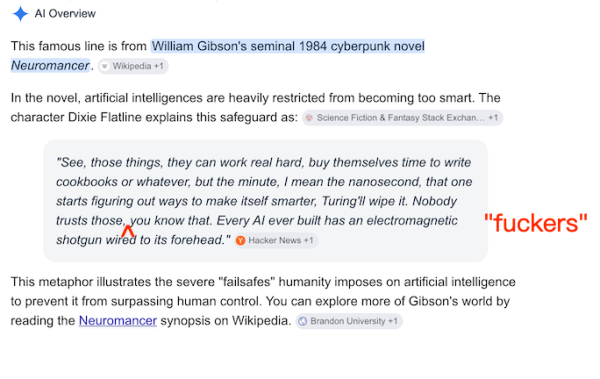
One can only wonder how many other key texts Google is bowdlerizing. Surely we can expect that a multi-trillion dollar company would quote key texts accurately?
Business: Media
“More than 340 newspapers block the Wayback Machine. What that means for the future of the internet” [Straight Arrow News]. “More than 340 national and local news publishers, from The New York Times to The Idaho Statesman, have blocked the Wayback Machine from archiving their stories due to concerns their proprietary content could get gobbled up by Big Tech companies to train AI tools like ChatGPT. That’s according to a new analysis by the Nieman Journalism Lab at Harvard University, which first reported that leading publishers across the U.S. have cut off access to the digital tool designed to preserve a historic record of the internet in the public interest. There’s no evidence tech companies are training AI models with archives from the Wayback Machine, which the nonprofit Internet Archive launched 30 years ago, and has since cataloged more than a trillion web pages. But the digital library is routinely used by historians, researchers and journalists — some of whom are now petitioning their employers to allow the Wayback Machine to preserve their work.” • That’s not good, especially since the lights keep flicking at archive.*. Linkrot is already bad. Now it’s going to get much worse.
The Conservatory
Reminds me of Stuart Davis:
Pablo Picasso
The Three Musicians, 1921
A hidden friendship pic.twitter.com/H6vxdx2t0k— Art Guide (@ArtGuide_db) May 23, 2026
“Collaged Denim Sculptures by Nick Doyle Unravel American Mythology” [This Is Colossal]. “For [Brooklyn-based Nick] Doyle, denim is a poignant, loaded metaphor for much of American culture and history. The material has roots in chattel slavery, when people enslaved in the South were dyeing cotton with indigo. There’s also its association with the brusque masculinity of James Dean and cowboy ruggedness, itself an extension of the gold rush and Manifest Destiny.” That’s just lazy writing. More: “The fabric, in many ways, is a stand-in for the contradictions, hypocrisies, and unreachable desires so bound up in American life. While researching the visual language of Americana in 2018, Doyle came upon a roll of denim discarded by a fashion designer moving out of his building. ‘At the time, I had no money, so I was making work out of material I found in the garbage or at my local hardware store,’ he shares. ‘As I was pulling [the roll] out of the trash, I noticed a network of ideas connecting in my brain… I felt the material reflected the historical complexities I was seeing in my research, as well as being reflected in my own familial history.’” • I have to admit, this is fun:

(“First Come the Dreamers” (2026), bleached and collaged denim on panel, 25 x 72 inches)
Maybe there’s something to this style or school after all (I don’t know what to call it, though, though I’m a big fan of Louise Bourgeois’ use of materials. Cornell’s boxes, too).
Groves of Academe
“Fear and Loathing in Palo Alto” [Washington Monthly]. “The argumentative spine of How to Rule the World, though, is [author Theo] Baker’s case against Stanford. Its culture, he argues, inculcates fraud. Venture capitalists throw ungodly sums of money at undergraduate ‘builders’ with little due diligence. Students, predictably, learn to misappropriate it, overclaim their abilities, and misrepresent themselves to their peers and to the public. Feeling pressure to appear accomplished and perfect, students engage in all manner of deception to keep up. And these issues, in Baker’s freshman year, extended all the way to Stanford’s presidency…. Baker harrowingly recounts reporting on [former Stanford president Marc Tessier-Lavigne’s research misconduct] while the university directed increasingly sharp (and ultimately baseless) legal threats his way. After its president’s resignation, Baker observes, the university scrubbed its investigation report from its website. Stanford likewise took no disciplinary action against geneticist Stan Cohen following his conviction for misleading investors in his biotech startup. And it quietly retained a football coach with multiple internal misconduct findings. On Baker’s account, misconduct in students’ economic and academic lives—cheating and plagiarism are rampant, he reports—flows from a culture of impunity that has long pervaded the university’s upper ranks. All this is why the university produces an unusual concentration of high-profile bad actors: Elizabeth Holmes, Sam Bankman-Fried (who didn’t attend Stanford, though both his parents are professors), cryptocurrency fraudster Do Kwon, and Juul co-founders Adam Bowen and James Monsees, among many others. It’s a persuasive argument, and How To Rule the World makes it with considerable pathos and wit.” • Oddly, the writer doesb’t mention Stanford’s cozy relationship wiith the Brownnose Institute, or Brownnose Fellow [sic] Jay Bhattacharya. The writer also seems to think Baker doesn’t understand Stanford’s tech bros. After DOGE, I think we all understand them quite well.
“The Story of Art + Water” [Dave Eggers, McSweeney’s Internet Tendency]. “For fifteen years or so, I’d been kicking around the idea of resurrecting the artist-apprentice model that reigned in the art world for hundreds of years. Again and again, I’d heard from young people who lamented the astronomical and ever-rising cost of art school. For many college-level art programs, the total cost to undergraduates is now over $100,000 a year. I hope we can all agree that charging students $400,000 for a four-year degree in visual art is objectively absurd. And this prohibitive cost has priced tens of thousands of potential students out of even considering undertaking such an education. For years, I mentioned this issue to friends in and out of the art world, and everyone, without exception, agreed that the system was broken. Even friends I know who teach at art schools agreed that the cost was out of control, and these spiraling costs were contributing to the implosion of many undergraduate and postgraduate art programs.” More: “It’s important to note that the current model for art schools is very new. For about a thousand years, until the twentieth century, artists typically either apprenticed for a master artist, learning their trade by working in a studio, or attended loose ateliers where a group of artist-students studied under an established artist, and paid very little to do so. These students would help maintain the studio, they would hire models, they would practice their craft together, and the studio’s owner would instruct these students while still creating his own work—usually in the same building.” For example, Manet. More: “Somehow, though, we went from a model where students paid little to nothing, and learned techniques passed down through the centuries, to a system where students pay $100,000, and often learn very little beyond theory.” And: “For the educational component of the Art + Water program, I did some napkin math and discovered something so simple that I assumed it couldn’t work: If each of these ten established artists taught just three hours a week, together they would provide these twenty emerging artists with thirty hours of instruction per week. These three hours wouldn’t put too great a burden on any one of the established artists, but the accumulated knowledge imparted each week by these ten established—and varied, and successful—artists would be immeasurable. And they would be able to do it for free. And because the thirty artists, established and emerging, would be sharing one pier, they’d be able to consult with each other regularly, even outside of class hours, and more mentorship and camaraderie would occur organically.” • This is really brilliant and I hope it does well.
“UT System makes it easier to shutter programs, fire faculty” [Higher Ed Dive]. “The revised policy allows presidents in the UT system’s nine universities to cut programs without faculty review and to remove individual faculty roles under a stripped-down appeals process. The change comes amid widespread concerns over academic freedom at Texas public colleges following new curricular rules, politicized firings of professors and a state law that reduced faculty governance bodies to advisory-only roles.” • Whatever UT now is, it’s not a university which is or should be governed by scholars. I bet the administrators are loving it, though!
Climate
“NERC Issues Level 3 Alert As Grid Faces `Unprecedented Challenges’ Due to Surge In Large Power Consumers” [Avian Flu Diary]. “Until relatively recently, the biggest threats to the grid were thought to be natural disasters (hurricanes, ice storms, severe space weather, etc.), `bad actors’ (cyber-threats, sabotage, etc.), or aging infrastructure (see ASCE report card on America’s infrastructure). ‘But over the past couple of years the rapidly increasing power demands from A.I. data centers, bitcoin harvesting, and cloud computing have added yet another potential failure point.’ Last summer the U.S. Department of Energy published a 73-page report that warned that if current schedules for retirement of reliable power generation (especially baseload) continue, without enough firm replacement, the risk of blackouts in 2030 could increase by 100× over current levels.” • Oh.
“Scientists discover the strange way CO2 cools part of Earth’s atmosphere” [Science Daily]. “As the Earth’s surface and lower atmosphere continue to warm, another part of the planet’s atmosphere is doing the opposite. Far above the ground, the upper atmosphere has been cooling significantly for decades. Scientists have long recognized this unusual contrast as one of the clearest signals of human driven climate change, but the exact physics behind it remained uncertain. Now, researchers at Columbia University say they have finally uncovered the mechanism responsible.” And: “Near Earth’s surface, CO2 traps heat that would otherwise escape into space, contributing to global warming. But conditions are very different higher up in the atmosphere. In the stratosphere, the atmospheric layer stretching from about 11km to 50 km above Earth’s surface, CO2 behaves more like a cooling system. The molecules absorb infrared energy rising from below and then release part of that energy back into space. As atmospheric CO2 levels increase, the stratosphere becomes even more effective at shedding heat, causing temperatures there to drop.” • Well, I’m glad that’s sorted.
“Sustained deoxygenation in global flowing waters under climate warming” [Science]. From the Abstract: “Dissolved oxygen (DO), as a vital material sustaining aquatic ecosystems, has declined markedly in oceans, lakes, and coastal waters, yet unbiased understandings of changing DO concentrations in each individual river segment globally remain a challenge. Here, we estimate DO concentrations in 21,439 rivers globally between 1985 and 2023, based on Landsat observations and climatic data, and examine their patterns and trends.” From the Science Daily summary: “78.8% of the rivers included in the study showed signs of deoxygenation. The strongest oxygen losses were found in tropical rivers located between 20°S and 20°N, including rivers in India. This result surprised researchers because scientists had previously expected rivers at higher latitudes, where warming is often more intense, to face the greatest deoxygenation risks. Instead, the study showed that tropical rivers already tend to have lower oxygen concentrations, making them especially vulnerable when oxygen levels continue to drop. Combined with faster deoxygenation rates, these conditions increase the likelihood of hypoxia events, when oxygen becomes too scarce to support many forms of aquatic life.” • Yikes.
News of the Wired
I am not feeling wired today.
Plantidote of the Day
Via AM:

AM writes: “A country scene in Moyasta, Western County Clare Ireland. Not as desolate as it looks, but worried about the horse being lonely.” Lovely photo!
Send your plantidotes as attachments to lambert [UNDERSCORE] strether [AT] protonmail [DOT] com. And if you put “Plant” or “Plantidote” in the subject line, I’ll be less likely to lose it. Gardens are fine. Gardening season approaches, at least in the Northeast! Fungi are honorary plants.
Comments
Hadn’t heard of Jackson until my better half got me to watch the recent Democrat gubernatorial debate. Jackson is not a polished politician but he comes across as very genuine, and I very much liked him. I’m not sure it will be enough to get him past those with more name recognition and money, but I was pleasantly surprised to see how well he was polling. Also not sure it was wise for Jackson to mention he was already on his 5th pacemaker(!), but credit for honesty.
Platner should counter the database of his social media posts with a list of Susan Collins’ actual votes that led to fewer concrete material benefits for Americans or death and destruction for those living abroad. It would not be a short list! For example in her first term, she voted for the Iraq war and the creation of the Dept. of Homeland Security. And so on.
… but “I’m pretty good at killing” (Obama), or “we came, we saw, he died” (Clinton) are A-OK. Real life torture, murder, and mass slaughter — Hi, Genocide Joe [waves] — are all part of the imperial norm, but step out of line with the wrong symbol and you’ll never hear the end of it.
Of course, one of the things that the PMC specialize in is symbol manipulation: creation, manipulation. Sale. Symbolic capital, if you will.
Stanford has had a serious ethics problem for a long time. I ran headfirst into it when I was there in the early 2000s. It was bad enough that I left after a short time. It wasn’t worth ending up in prison over. They all think rules and regulations don’t apply to them. Maybe because they think they’re specialer, I don’t know. And this was in the biomedical sciences. It’s endemic to the university.
(hi, everyone-I hope you all are well. Lambert, I’m glad you’re back.)
(So far as I can tell from his writing and reputation, Knuth is the closest thing to a saint there is in Computer Science.)
I’m glad to be confirmed in my priors on Stanford. Now I can be as snarky as I want!
Pleased to have you back, Petal!
Hadn’t before made a connection between Stuart Davis and Picasso. Good one!
The Nick Doyle made me remember when mother disapproved of jean wearing. She was raised on a farm and that’s what you wore when you worked in the field. Now you can buy a new pair of ripped and beaten up jeans for $950 at Bloomingdale’s.
Troy Jackson