
Birdsong of the Day
Moar mimidae:
Riverbreaks CA_east side, Holt, Missouri, United States. A whole chorus, with a Mourning Dove, a Tennessee Warbler, and an Eastern Towhee.
In Case You Might Miss…
(1) Trump’s bunker.
(2) American Empire Is Here to Stay.
(3) The AI-inflected crisis artists are facing, in 4 charts.
Look for the Helpers
This is so on-point for a liberal shibboleth I’m immediately suspicious. Nevertheless:
The curse of being the smart child is that you are genetically coded to be your family’s unpaid crisis manager—and the world’s. A massive 2024 population registry study published in The Economic Journal proved that higher general fluid intelligence directly causes increased… https://t.co/4r4zl51OzM
— Hereafter (@idyllicmusing) May 19, 2026
My email address is down by the plant; please send examples of “Helpers” there. In our increasingly desperate and fragile neoliberal society, everyday normal incidents and stories of “the communism of everyday life” are what I am looking for (and not, say, the Red Cross in Hawaii, or even the UNWRA in Gaza).
Politics
Trump Administration
“Trump pulls back curtain on White House ballroom’s fortress-like defenses above and deep below” [FOX]. “President Donald Trump gave reporters a fresh look Tuesday at construction of the new White House ballroom, touting it as a hardened security structure that runs six stories into the ground. ‘This goes down very deep,’ Trump said Tuesday from outside of the White House. ‘These are already down two floors. That is down about six stories deep. That’s big stuff. Normally, when you build a ballroom, you build it flat.’ Trump said the future White House ballroom not just as an event venue.” • It’s a bunker!
“World Tyranny Financial” [[citation needed]]. “The Trump family’s World Liberty Financial is borrowing against its own thinly-traded token. New reporting suggests the company may have partnered with individuals connected to a US-sanctioned human trafficking operation. And Justin Sun, who was among the project’s earliest and largest investors, has denounced it as “ ‘World Tyranny,’ not ‘World Liberty Financial’ ” as his $75 million investment remains frozen. As the president’s family’s shady dealings continue to mount, SEC enforcement actions have collapsed to twenty-year lows. The CFTC says it doesn’t need staff when it has AI. The nominee for Federal Reserve chair is deeply invested in crypto and AI. And the new leader of the Justice Department is the guy who shut down the agency’s crypto enforcement despite an ethics commitment not to participate in crypto matters before divesting his own personal crypto wealth.” • Everything’s going according to plan!
“Trump Requests $1.2 Trillion To Have” [The Onion]. “ ‘I’m calling upon Congress today to immediately provide me with $1.2 trillion in funding that I currently do not possess but which I will possess once it is given to me,’ said Trump, acknowledging that he had previously asked for just $900 billion but was now requesting more so that he would have more. ‘Even as we speak, I do not have this money, and the only way for me to get it is through swift budgetary action. I’ve gone too long without $1.2 trillion that I’d very much like to have so I can spend it on things I want. It is also possible I’ll want to have more money at a later date, and I will request it then.’” • Trump’s cadence is hard to capture, but I think The Onion does it well.
Trump sued the IRS for $10 billion in January while simultaneously controlling the agencies and lawyers on the other side of the case/“Trumpworld’s presidential gold rush” [Axios]. “With each passing month, Trump is weaving the financial interests of his family, his allies and his political movement more tightly than ever into the fabric of the American presidency. The weaponization fund grew out of an extraordinary legal conflict: Trump sued the IRS for $10 billion in January while simultaneously controlling the agencies and lawyers on the other side of the case.” You’ve got to admire his commitment to the bit. More: “The taxpayer-backed fund will be overseen by a five-member commission appointed by acting Attorney General Todd Blanche, Trump’s former personal attorney. Bypassing congressional approval, the fund could extend compensation to Jan. 6 defendants, conservative activists, former Trump aides and other allies who have faced investigation. ‘The machinery of government should never be weaponized against any American,’ Blanche said in a statement, calling the fund an effort ‘to make right the wrongs that were previously done.’… The Justice Department’s announcement came amid mounting scrutiny of Trump’s most recent financial disclosure, which revealed more than 3,700 individual stock trades last quarter. The trading activity — involving some companies heavily exposed to federal policy decisions — represented a staggering escalation from the previous quarter, when Trump disclosed just 380 transactions.”
“Top Treasury lawyer resigns as Trump, IRS settlement announced” [The Hill]. “The Treasury Department’s chief legal officer resigned Monday following the Department of Justice’s (DOJ) launch of a $1.8 billion “anti-weaponization fund” that could provide payouts for rioters convicted in connection to Jan. 6, 2021, and others who claim they were wrongfully targeted under the Biden administration. President Trump nominated Brian Morrissey to be the department’s general counsel last year, and he has served in the role for the past eight months. The attorney was previously the principal deputy general counsel for the Treasury Department and was a clerk for Supreme Court Justice Clarence Thomas…. ‘No one can be both plaintiff and defendant in the same case. And no president can concoct a fake case for $10 billion in damages against the government so he can be plaintiff and defendant and then ‘settle’ his bogus case against himself as a judge,’ [Rep. Jamie Raskin (D-Md.)] said. ‘This is simply not a genuine case or controversy as required by the Constitution. But Trump’s DOJ is not arguing any of this because it is in on the scam.’” • Here is the Legal Information Institute on Article III, Section 2, Clause 1, and “cases and controversies.” “The term implies the existence of present or possible adverse parties whose contentions are submitted to the Court for adjudication” (In re Pacific Ry. Comm’n). “The controversy must be definite and concrete, touching the legal relations of parties having adverse legal interests” (Aetna Life Ins. Co. v. Haworth). “those words limit the business of federal courts to questions presented in an adversary context” (Flast v. Cohen). Raskin is arguing the parties are not adverse.
* * * “The quiet revolution in federal payment integrity” [Federal News Network]. “Yet inside the Bureau of the Fiscal Service — a branch of the Treasury Department that most Americans couldn’t name — a determined group of public servants has spent the last two years systematically closing the gaps through which fraudsters drain federal programs. The numbers show they’re getting somewhere. In fiscal 2025 alone, Treasury and its Do Not Pay Business Center helped agencies prevent, detect and recover $11.7 billion in potential fraud and improper payments.” More: “Check fraud surged in recent years, driven in large part by a rise in mail theft. Treasury checks became a favored target because they were guaranteed not to bounce, widely accepted and until recently, surprisingly easy to alter. “Check washing” — stealing a check and chemically or digitally altering the payee name or amount — became a real business model for fraudsters. The scale of exposure was enormous: In 2024, the Federal Reserve processed 36 million government checks valued at $1.75 trillion. Treasury’s Check Verification System (TCVS) already let financial institutions confirm basic check details — issue date, check number and payment amount. But until November 2024, institutions couldn’t verify whether the payee name actually matched Treasury’s records. That one gap was enough for a fraudster to wash a check, swap the name and still clear the verification process. In November 2024, the Bureau of the Fiscal Service upgraded the TCVS API to add payee name validation — a direct strike at the check-washing methodology. For the first time, a bank could confirm in real time whether the person presenting a check was the person Treasury actually intended to pay.” More: “Do Not Pay has been underused largely because the legal compliance process for participating is slow and resource intensive.” • After DOGE’s work at the BFS, anything that gives the Executive the power to stop payments makes me very, very nervous, despite the undeniable “good government” aspects of this initiative.
Election 2026
“Trump’s MAGA brand dominates Georgia primary night” [Politico]. “The MAGA takeover of the Georgia GOP is nearly complete…. On Tuesday, the Trump allies marched on: Trump-backed Lt. Gov. Burt Jones clinched a spot in the gubernatorial runoff on Tuesday alongside billionaire Rick Jackson, who told supporters he’d govern like the president ‘with a southern tone.’ In the GOP Senate primary, Rep. Mike Collins, a staunch MAGA ally, advanced to a runoff. And House candidates Jim Kingston, Houston Gaines and Clay Fuller won their races by wide margins, boosted by the president’s endorsement. Meanwhile, longtime Trump antagonists — especially those who denied the 2020 election was ‘stolen’ — lost their primary battles: Secretary of State Brad Raffensperger, Attorney General Chris Carr and Gabriel Sterling, a former top Raffensperger aide. The results offered the clearest sign yet that Georgia Republican voters increasingly want their political future tied to Trump-style politics and messaging — a shift in one of the nation’s premier battlegrounds that could shape elections in 2026 and beyond.” • Woo hoo!
The president [has cemented] his viselike grip on the GOP even as his overall approval numbers continue to sag.“Trump picks off Massie in Kentucky” [Politico]. “President Donald Trump finally got his revenge on Kentucky Rep. Thomas Massie. The libertarian-leaning iconoclast who has been a hindrance to some of the president’s biggest priorities lost to Trump-endorsed former Navy SEAL Ed Gallrein in Kentucky’s 4th District on Tuesday, in a primary that became the most expensive intraparty House fight on record. It’s the latest in a string of primary victories for the president that cements his viselike grip on the GOP even as his overall approval numbers continue to sag.” • That’s what they call a contradiction.
“The Platner Trap” [David French, New York Times]. “I don’t want politicians to be authentic. I want them to be decent. I want them to be honest. I want them to be competent. And if they fail those tests, they don’t redeem themselves by opposing President Trump. If you’re a conservative watching Democrats talk themselves into supporting Graham Platner, the Maine Democrat who until recently wore what sure looked like a Totenkopf tattoo (he covered it up after it became a political embarrassment), you’re probably experiencing déjà vu. To a lesser but still familiar degree, I’m seeing Democrats engage in the same process of absurd accommodation and justification that Republicans use to excuse their deep love for Trump.” • And if Platner’s “competence” is nuking the Maine Democrat establishment, and then centrism? I think that for many voters, in both parties, and at least since 2016, have the sense that “things cannot go on as they are.”
“Court denies Virginia’s request to reinstate congressional map that would benefit Democrats” [Amy Howe, SCOTUSblog]. “The Supreme Court on Friday evening turned down a request by Virginia’s attorney general and other Virginia Democrats to allow the state to use a new congressional map, which would have been expected to strongly favor Democrats, in the 2026 elections. The denial came in a brief, unsigned order sent to reporters at 6:30 p.m. EDT on Friday – just 15 minutes after the court’s Public Information Office distributed the reply filed by Jay Jones, the Virginia attorney general, and Democratic legislators. There were no public dissents from the order. The effects of the court’s order are likely relatively minimal, because Virginia Gov. Abigail Spanberger had already indicated earlier this week that the state would not use the 2026 map in the upcoming elections.” And: “The Virginia General Assembly had adopted the new map in February. But before the state could actually use the map, it needed the state’s voters to approve an amendment to the Virginia constitution that would give the General Assembly the power to draw a new congressional map outside of the normal cycle following the decennial census. In April, voters approved an amendment to the state’s constitution that gave the General Assembly the power to do so. Nevertheless, a divided Virginia Supreme Court struck that amendment down on the ground that the Legislature had not followed the correct procedures when it put the new amendment on the ballot. The majority explained that under the state constitution, the Legislature must approve a proposed amendment to the constitution during two different legislative sessions, which must be separated by an election to the General Assembly’s House of Delegates. Although the Legislature had voted on the proposed amendment for the first time on Oct. 31, 2025, the majority said, more than 1.3 million votes had already been cast by then – and, therefore, ‘the General Assembly passed the proposed constitutional amendment for the first time well after voters had begun casting ballots during the 2025 general election.’” • Not a bad argument. It’s amusing that the Democrats lost their case for a similar reason Musk lost his: They butchered the timing (Musk with respect to the statute of limitations, Virginia Democrats with respect to their own Constitution (!)).
Realignment and Legitimacy
“The US is not a nation-state, much less a Christian one” [Religion News]. “Christian nationalism thus has to do with advancing the claim that Christianity has special standing in the country. As religion scholar Jerome Copulsky makes clear in a fine essay on this site, the desire to do so has a long history, in large part because the framers of the Constitution went a long way toward making sure that wasn’t the case — rejecting religious tests for office, barring religious establishments and guaranteeing religious free exercise. According to White House faith adviser Paula White-Cain, Sunday’s daylong federally underwritten Jubilee of Prayer, Praise & Thanksgiving on the National Mall is about ‘rededicating the country to God.’ The thing is, our nation wasn’t dedicated to God in the first place.” • Amen.
“‘They own it’: A split-screen view of data centers comes to central Arkansas” [News from the States]. “More than 1,500 data centers are in various stages of planning and development across the country, most in rural areas, according to a Pew Research Center analysis of the Data Center Map, a company that has provided publicly available data on data centers since 2007. Sentiment toward data centers is flagging, too, with 70% of Americans opposed to data centers being built in their community, a Gallup survey released last week found.” And but: “The answers from the press conference and informational websites still didn’t convince skeptics like Kathy Wells, the president of the Little Rock Coalition of Neighborhoods. … ‘I need to know more before my cost-benefit columns begin to be complete,’ she said. Local elected leaders needed to step up and talk to the community instead of allowing the regional chamber to do it in order to start filling those columns. ‘They own it. They’re on the election ballot in November, most of them, and they need to step up and make this public, and command enough information that they can speak about this,’ Wells said. ‘They aren’t going out there making speeches. They’re letting the chamber do it all.’” • And the country’s cost-benefit analysis? Who’s doing that?
Geopolitics
“American Empire Is Here to Stay” [Compact]. ” Pax Americana isn’t going anywhere anytime soon. There are a few straightforward material reasons: The dollar is still the reserve currency and the anchor of the global financial system, and no credible alternative has emerged. The US navy is still the guarantor of naval shipping lanes across the world, facilitating global trade; no one else seems up for taking up that responsibility either.” And: “[T]here is a deeper reason for America’s enduring preeminence. The basis of American power is neither merely military nor economic. Rather, it is based on its social power, which in turn has its roots in revolution. Present-day America is the legatee of two earth-shattering world-historical revolutions: that of 1776 and that of 1861 to ‘65… The result of this history is that the United States doesn’t have a single source of power, but many, which creates a polity that can more easily adapt and renew itself—a factor often underestimated by America’s adversaries. It is not a coincidence that it is also the world’s only superpower…. [H]owever much Americans may wish to retire from world politics, America isn’t going to be a ‘normal’ country anytime soon. Its preeminence on the world stage in the future is a given, for good and for ill. It will remain the leading capitalist power in the world and the guarantor of world order and global capitalism because it is the only country that can take up the necessary responsibility; none of the supposed challengers have the desire or capacity to do so. It is telling that declarations of the end of Pax Americana have coincided with major crises in global capitalism.” • Hmm.
“The Pentagon Wants 300,000 Drones But China Controls The Magnets” [OilPrice.com]. Fun fact: “An F-35 contains more than 900 pounds of rare earth materials.” • We’re spending a lot of money on REalloys, a monopoly supplier. It’s not clear to me from the link, which is well worth a read, whether REalloys will be able to meet the Pentagon’s supply requirements.
“The unfinished weapon: Why America’s push for speed in defense acquisition could still field systems that can’t survive the fight” [Federal News Network]. “The hardware often stays the same. What changes is the software and the tactics layered on top. That is software-defined warfighting: the ability to change what a system can do without changing the hardware….. If you cannot change the software during the fight, you’re not fielding a capability. You’re fielding an unfinished weapon…. Software now sits inside the kill chain, shaping how data moves, decisions are made and effects are delivered. When it cannot evolve, the entire system falls behind. The military already understands continuous adaptation. Logistics continuously resupplies fuel and ammunition. Intelligence systems constantly refresh the operational picture. Commanders revise plans as new information emerges. Software must function the same way.” • “Only an AI can weave ice fast enough to adapt.” — William Gibson, Neuromancer.
“Palantir AI technologies used in Israeli attacks, say reports” [Anadolu Agency]. “Speaking to Anadolu during protests against Microsoft’s cooperation with Israel at the company’s 50th anniversary event in April 2025, former Microsoft employee Ibtihal Aboussad said Palantir’s technologies played a critical role in Israeli military operations. ‘Palantir is essentially weaponizing artificial intelligence and also weaponizing data analysis to make deadly decisions,’ Aboussad said, alleging that Israeli authorities collect data from social media platforms, messaging apps, phone calls, and location services in Gaza to support targeting operations. She also warned that military officials could try to evade accountability by attributing attack decisions to technology, saying another dangerous aspect of Palantir’s systems is that they function as ‘a shield protecting Israel from legal accountability.’ Aboussad said technological infrastructure provided by Palantir was used in Israeli-developed AI systems such as Lavender and Where’s Daddy, which have reportedly been widely employed by the Israeli military for target identification in Gaza. ‘I hesitate to even call it software, because it’s clearly designed with the surveillance and warfare and killing purpose,’ Aboussad said, adding that the Israeli military also used the systems in detention operations and raids carried out in the occupied West Bank.” • Anybody think this technology won’t be used domestically?
Vaccines
“‘Patient autonomy’ has nothing to do with childhood vaccine policies” [Stat]. “The Trump administration has made sweeping changes to vaccine policy over the past year justified by invocations of patients’ ‘personal autonomy.’” • Like Jesus said: “Infect thy neighbor as thyself!”
Business
Banking: “I read a horrible book about A.I. and have never felt worse about the state of the humanities” [White Hot Harlots (via Lyman Alpha Blob)]. “Way back in 1971, technologists and scientists and other sorts of smart academic types we’d now call “futurists” gathered for a future-type convention at Georgetown University. They were presented with a thought exercise: hypothetically, what would be the easiest way to install a system of mass, intrusive surveillance with minimal public pushback? In response, they invented debit cards. Seriously. Click here and flip to page 8 [correct. The author is from Stanford. Of course]. These eggheads intuited something essential about the mind of a populace warped by consumerism: us proles may think we like high-falootin’ ideals such as freedom and privacy, but when faced with the potential to weaken or even eliminate any of these for the sake of convenience, we’ll take convenience. When convenience is compounded by a sense of status and/or safety, we’ll make even rasher decisions. And so even if that’s not how debit cards were sold to us, we all now realize they allow many varieties of nefarious actors to track our purchases, and also open us to a strong possibility of identity theft. That sucks, sure, but it’s just so much of a hassle to have to run to the ATM or fill out a check. A couple of decades of this being the status quo pass, and oh whatta ya know, now some stores are just outright not allowing you to pay with cash, and you have to swipe your card at parking meters. The same gist applies to automated tolling systems. You don’t need to wear a tinfoil hat to realize these allow the government to track your movement, and that such data can be applied in myriad ways that will probably never benefit you. But, seriously, do you remember how much of a hassle it was to have to pull over and fish for change? Same with GPS: who cares if Google knows how often I frequent Bob’s Pornography Depot? I need to get there on time, dammit!” • Conveniencing ourselves to death….
Rentiers: “Insurance brokers are getting big commissions to keep retirees in Medicare Advantage plans” [MarketWatch]. “Your insurance broker is getting a hefty commission to put you — and keep you — in a Medicare Advantage plan. Insurance brokers reaped $10.1 billion from insurers in 2022, up from $3.9 billion in 2014, for signing up and renewing Medicare Advantage subscribers, according to a new study published in JAMA Internal Medicine. In 2022, 73.6% of broker spending was for renewal enrollments.” • How nice for them!
Rentiers: “Emergency medicine revenue at risk: Navigating the algorithmic squeeze” [Health Care Dive]. “Emergency medicine (EM) has always been subject to payer scrutiny, but today’s reimbursement pressure is different: it is more aggressive, more automated and less transparent. Across the country, EM physicians are seeing an increase in diagnosis-based downcoding and black box payer algorithms that have increased the financial and administrative burdens on EM groups….. The concern is not simply that claims are being reviewed. Payers have a legitimate interest in claim accuracy. The concern is that many of these reviews fail to reflect the clinical reality of emergency care. Emergency physicians evaluate and treat patients based on presenting symptoms, limited information and potential risk. They do not have the luxury of hindsight, yet payer algorithms increasingly apply retrospective logic to decisions made in real time.” • “Downcoding.” What a great word. This is an excellent review of how “EM visits are documented and coded.”
AI: “Mayo Clinic is Using AI to Listen to Emergency Room Visits” [404 Media]. “Mayo Clinic, the massive U.S. hospital network, is using what it describes as “Ambient Listening” to record patient interactions with nurses, including in emergency rooms, then using AI to process that collected data. The recording is opt-out, rather than opt-in, and at least some patients are likely not aware the recording is happening. The recording brings up questions of informed consent and whether the generated notes may be accurate enough. A study last month found that AI-powered scribe tools sometimes produce much less accurate notes than humans depending on the situation.” And: “A recent study found that human note takers create much better notes than AI-powered scribe tools. In some specific cases, the AI performed especially poorly compared to a human: when there was background noise; when the clinician and patient were wearing masks; and to a lesser extent when the patient had an accent, according to the American Medical Journal.” • Oh, great. One more reason for hospital administrators to forbid mask-wearing. I can’t wait for the next respiratory pandemic!
AI: “In Musk v. Altman trial, the entire AI industry lost” [Axios]. • That’s a damn shame.
AI: “OpenAI asks users to hand ChatGPT their bank logins months after pitching the same with health records” [Justin Sun, SunRise AI]. Note that Justin Sun is Mothra to Elon Musk’s Godzilla. “US Pro subscribers ($200/month) can connect to 12,000+ financial institutions via Plaid, including Schwab, Fidelity, Chase, and Capital One. ChatGPT cannot make changes to accounts or see full account numbers but can see balances, transactions, stock portfolios, and liabilities like mortgages and credit card debt. Users can disconnect anytime; OpenAI has up to 30 days to delete data.” • What could go wrong? And why thirty days? Are they deleting the data by hand in Manila or Dhaka?
AI: “‘Comically bad’ datasets used to train clinical models for stroke and diabetes” [Retraction Watch]. “Scrolling through an online image dataset, Adrian Barnett, a statistician at the Queensland University of Technology in Australia, pointed out a few familiar faces. Sylvester Stallone as Rambo, and then again on the red carpet. ‘This is just ridiculous,’ Barnett said. George Clooney, Angelina Jolie and Daniel Craig all appear more than once, often with the same image. ‘You can see,’ Barnett said, this is just a comically bad dataset.’” Tragically bad, if you’re a patient whose clinician is relying on a model built with the bad data. More: “This particular dataset, collected in a folder titled ‘droopy’ and hosted on an open-source repository called Kaggle, underpins a paper published in Scientific Reports – not as a find-the-celebrity game, but as a training set for a predictive clinical model for early detection of strokes. The paper is the most recent example of a much wider problem that Barnett and his Ph.D. student Alexander Gibson have documented with Kaggle, which is owned by Google and hosts datasets uploaded by users that researchers and machine learning practitioners can use to build predictive models. By examining two other Kaggle datasets on stroke and diabetes, both of which included tabular patient data, Gibson and Barnett traced how the data move through the scientific literature and in some cases, into clinical use. Their work, described in a preprint posted to medRxiv in February, already has led to several retractions of the papers using these dubious datasets.”
“Twenty-Seven Characters” [Math of Politics]. “The main character of the story is HaluEval, a new ‘standard benchmark’ for measuring whether a large language model is hallucinating — producing fluent, plausible-sounding text where it ought to be reporting a fact. The benchmark contains around 35,000 examples, each labeled as a hallucination or not. Researchers run their model against it; the resulting accuracy number ends up in papers, on leaderboards, and in vendor pitches. A recent analysis points out that you can score 93.3% on HaluEval by ignoring the model entirely and flagging any answer over 27 characters as a hallucination. A neighboring benchmark, TruthfulQA, falls to the same kind of trick — picking the shorter of the offered candidate answers nets 65% accuracy against a 50% random baseline. The trivial classifier beats the careful one. This is funny on its surface and, I think, much funnier underneath. The funny-underneath part is that a benchmark for classifiers is itself a classifier, and the benchmark just got caught doing exactly the thing it was built to catch the models doing.” • BWA-HA-HA-HA-HA-HA-HA!!! It’s bullshit all the way down.
AI: “The AI-inflected crisis artists are facing, in 4 charts” [Blood in the Machine]. “Three researchers at Carnegie Mellon University, Harry Jiang, Jordan Taylor, and William Agnew, surveyed nearly 400 professional visual artists about how generative AI has changed their working lives, income, opportunities, and outlook, and compiled the results into a paper they presented at the ACM (Association for Computing Machinery) CHI conference in April. Their findings are stark and alarming. They all but confirm that artists are experiencing nothing short of an AI-inflected crisis. In some cases, conditions are even more dire than I’d thought. But the work also offers keen insights into the details about how it’s all playing out, and even, dare I say, some reasons for hope.” So, AI-driven autocoprphagy from here on out? As the well-springs of genuine art are sucked dry? And: “These numbers suggest that we’re looking at the degradation of a skilled trade in realtime, and the extent of the aggravated resentment artists feel make perfect sense. Here’s a technology product, after all, that’s been trained on their work without their consent, and is now producing subpar output that’s driving down their wages and rendering work less rewarding. And many have to encounter the AI-generated artifacts that make this fact unignorable every day. That, my friends, is how you get 99% of workers across an entire industry to dislike your technology.” But note the top line on this handy chart:
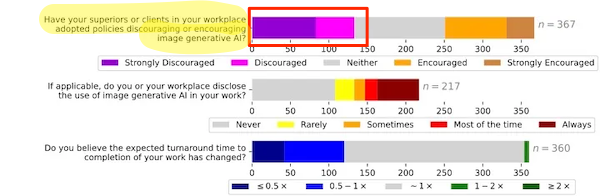
More: “That bifurcation here suggests that there will be a sustained interest in—and market for—art created by humans, and, perhaps more importantly, a potential source of political power for artists to tap into to bolster their position with employers in fields where that premium is placed.” And: “ ‘On a more tangible level, it’s going to be quite clear that AI policy is labor policy,’ [study author Harry Jiang,] adds.”
Today’s Fear & Greed Index: 61 Greed (previous close: 60 Greed) [CNN]. One week ago: 64 (Greed). (0 is Extreme Fear; 100 is Extreme Greed). • Still drifting lower….
Rapture Index: Closes down one on Oil Supply/Price. “Despite all the fighting in the Middle East, oil prices have declined” [Rapture Ready]. Record High, October 10, 2016: 189. Current: 182. (Remember that bringing on the Rapture is good.) • I’d never checked the FAQ for this site. It’s everything I expected, and more.
Climate
“A deep‑ocean climate plan wins rare EPA approval, but is sinking plants in the sea the answer?” [The Conversation]. “Innovators who are working on ways to pull carbon dioxide out of the atmosphere to fight climate change are having a tough time lately…. However, there may be a bright spot for this industry, and it comes from an unexpected source: The U.S. Environmental Protection Agency quietly decided in March to grant a research permit under the Marine Protection, Research, and Sanctuaries Act to a Houston-based carbon removal startup.” And: “The company, Carboniferous, aims to assess the potential to durably lock up greenhouse gases by harvesting plants that took in carbon dioxide on land and sinking them to the bottom of the ocean. This approach is often called ‘ocean biomass sinking,’ or marine anoxic carbon storage.” • Hmm.
The Gallery
Looks like rain:
Gustave Courbet
Marine, 1866 pic.twitter.com/VrMSRCvYA0— Art Guide (@ArtGuide_db) May 16, 2026
I’m trying to call to mind a pre-19th century painting of rain, but I can’t do it. Readers? (Courbet was, apparenntly, a Realist, not an Impressionist.)
Photo Book
“Discover the 6 photographers of the 10th Season of Google Creator Labs” [Vogue]. • It could be an anchoring effect from Google Search, but I think all these photos are bad, bad, bad.
Sports Desk
“How cricket bent its rules” [The New Statesman]. “With the English cricket season having just begun, many of the best English players are not casting long shadows on England’s green and pleasant fields but playing in intense heat on hard-baked Indian grounds, driven by money.” More: “A sport which began as commercial entertainment played by hired performers in England in the middle of the 19th century is similar to its current iteration, except the centre of the game has moved to India and the Indian Premier League (IPL) dominated by Mukesh Ambani, one of the richest businessman in Asia, and other Indian magnates. India provides 80 per cent of world cricket’s income and its takeover of this very English game, unthinkable two decades ago, means that for the first time a non-white country runs a major international sport. In contrast, the Saudis, having poured millions into golf hoping to transform it and take control, have now withdrawn, realising they cannot wrest control from the white men of Europe and America who have always run the game.” And: “The 19th-century English businessman who transformed the game was William Clarke, a portly, one-eyed former bricklayer, who realised talented cricketers could be lured away from their existing employers by offering them more money. He set up a touring team of leading players in the 1840s, using the nascent railway network to take the game to various parts of England.”
The Conservatory
“Kim Gordon’s Capitalist Realism” [Jacobin]. The headline being a shout-out to Mark Fisher. “[The] improvisational, found-object style that started her career as a musician can still be heard on Gordon’s new album, Play Me (Matador)…. Gordon is seventy-three years old — for context, Bruce Springsteen is seventy-six and Bob Dylan is eighty-four — though Play Me is far from being a work of reminiscence or nostalgia. It is, in Gordon’s characteristically experimental way, a political album…. Gordon recognizes the urgency of speaking to the political present while also bringing a sense of self-awareness about the hazards of doing this. The result is a bracing record that musically and lyrically meets the moment through elements of attention, subversion, and refusal: features that have long defined her artistic career.” • For example:
(Lyrics.) Hard to march — or dance —to.
News of the Wired
“Do You Kebberfegg?” [Library Worklife (2006)]. So I don’t have to use Google alerts. “But another, really cool, option for finding RSS feeds is a tool called Kebberfegg, developed by web search maven Tara Calishain. Yes, it’s kind of a strange name—a pronounceable version of Keyword-Based RSS Feed Generator. Instead of trying to remember where the best RSS feed search tools are and how to use them, Kebberfegg builds RSS feeds around the specific information you’re looking and in the types of sources you would probably find most useful. An example is the best way to explain how Kebberfegg works. Say you’re interested in staying up to date on the issue of space tourism (who knows? Maybe some day, it’ll be cheap enough for anyone to become an astronaut). Head over to Kebberfegg, type your query, “space tourism,” into the search box and then select which of the nine categories you want to use. For this search, you might want to get RSS feeds from news search engines, scientific and medical sources, and technology sources, so select those categories and click Submit.” • Kebberfegg still exists, although, sadlyi, it draws from a small corpus of news feeds. What I woudl really like to do is put all the names of all the DOGE weasels into an automatic keyword search, so I can make sure what they did follows them for the rest of their lives.
Plant of the Day
Via TH. Wow:

TH writes: “ ‘Took this picture in Long Beach (CA) in the Naples Island neighborhood. You can see by the format that it’s an iPhone product. I had thought the lens was so wide-angle that even at close distances everything was focused, and am ashamed to say I am only just noticing that that’s not the case - - - or maybe there was some motion? But that top flower is definitely sharper (if not completely sharp) than the lower ones.” • I’m so pleased to have previous Water Cooler readers send me Plantidotes. Moar, please!
Send your plantidotes as attachments to lambert [UNDERSCORE] strether [AT] protonmail [DOT] com. And if you put “Plant” or “Plantidote” in the subject line, I’ll be less likely to lose it. Gardening season approaches, at least in the Northeast. Prep work is fine!
Comments
There are old-fashioned color photograph printing technologies like Autochrome that have that soft, slightly granular feel, with very rich colors.
Goes well with the old-fashioned subject matter, too.
Perhaps controversial, but I’m glad for the ballroom. Using the rose garden was totally inadequate. Yes, i get it, half the country hates the orange man but he’ll be gone in another two years and we’ll (both Team Red and Team Blue) still have the facility above ground for hosting parties, and below ground for whatever purpose it’s needed.
I do mind this ballroom, since it’s going to be tasteless and gaudy (and will also, at least I read in the papers, interrupt the line of sight from the White House to Capitol Hill, throwing L’Enfant’s design for the city out of whack1). Anyhow, a man with balls the size of Trump’s needs room for them. A room, in fact.
I think the more interesting question is, well, what looks a lot like a hidden agenda: The lower depths, the bunkers beneath the ballroom, which couldn’t possibly have been excavated under the White House proper. It’s hard to begrudge Trump a bunker, given two assassination attempts and random gunmen trying to climb the White House fences. More to the point, I suppose, is that if there’s ever blowback from the decapitation strikes we’ve enabled and normalized, a bunker might be very useful. I wonder how long it takes to get from the Oval Office to the ballroom, how fast the elevators go down, and so forth.
NOTE
1 Ballgoers will no doubt be “a wretched hive of scum and villainy” billionaire donors, but such a clarification is salutary.
since there was already a https://en.wikipedia.org/wiki/Presidential_Emergency_Operations_Center
Plantidote