
I use AI in two places: Lightroom, and this site’s server. In neither case do I surrender a smidgeon of creative control. I have the privilege of being a centaur, and not a reverse centaur.1. Of course, I’m not mandated to use AI by (greedy, authoritarian, and moronic) university administrators, by (greedy, authoritarian, and moronic) hospital administrators, by (greedy, authoritarian, and moronic) managers, or by (greedy, authoritarian, and moronic) owners of platforms like GitHub. I’m also of a certain age, and not likely to be put into any of those positions. So my use cases may not be typical. In this post, I’ll look at Adobe Lightroom. In a future post, I’ll look at interacting with my web host’s chatbot.
The good folks [snort] at Adobe are rapidly building AI features into their venerable Lightroom Classic, which is a tool for organizing and enhancing digital photographs, much as one used to do with a darkroom and file cabinets. (The “classic” version has local storage, as opposed to [vomits quietly] The Cloud, so I actually own my photographs in practice as well as theory). One such feature is “culling,” where Lightroom purports to distinguish good photographs from bad; but I prefer to cull my own photos, thank you very much (and tag them, too; I view tagging as a creative act). I don’t want some algorithm culling a photo with random or serendipitous effect or composition, which it will, by definition. Two Lightroom AI features I do use are Removal and Denoising.
Here is a screen shot of Removal:

The red splotch at right is the area I selected where generative AI should remove something, like an encroaching foot or the unwanted arm of a telephone pole. I can adjust the shape of the splotch by adding or subtracting with the selection tool. Once I press the Remove button, Lightroom will remove the offending object beneath the splotch and replace it with whatever it calculates the background of that object to be/have been. This is handy. It’s a continuation of established darkroom practice, and I don’t object to it.
What I do object to is, say, influencers removing the Sherpas from the selfies they’re taking on Mount Everest, which if Lightroom cannot do today, it will be able to do tomorrow, turning the entire world of photography, documentary and otherwise, into the Great Soviet Encyclopedia, at scale:

To put this another way, if capital were under democratic control, I would vote against my own convenience, and for the preservation of the photographic art.2
Now to Denoising. I photograph mostly from evening to full night. So I have noise issues. From a fine article on noise in Photography Life:
Digital noise, or electronic noise, is randomness caused by your camera sensor and internal electronics, which introduce imperfections to an image.
You can think of noise as, essentially, a “backdrop” for every picture you take. It will always be there, no matter what you’re photographing. Your goal, then, is to have the actual data (i.e., the real scene you’re trying to photograph) overpower this background. The best way to do that is to capture more light.
Consider a situation where you don’t capture enough light in the field, and the noise in an image overpowers the signal – the actual information. First of all, your photo will be extremely dark. You didn’t capture much light from the scene. But beyond that, when you attempt to brighten the photo on your computer, you’ll make both the signal and the large proportion of noise more visible, resulting in a photo that looks hugely grainy and discolored!
If you’ve ever heard the term signal-to-noise ratio, this is what it’s referring to. A photo with “more noise” isn’t always a bad thing for image quality – because the signal might have increased as well, perhaps by a proportionally greater amount, making the noise less visible overall. What matters here is simply the ratio.
So, how do you get the best image quality in your photos? It’s all about capturing more actual signal so that you can overpower the backdrop of noise that will always be present. You can do this by using a longer shutter speed, setting a wider aperture, or photographing a more luminous (brighter) scene.
But I don’t want that other, more luminous scene. I want this scene! So what to do if there is no more light to be had?3 Well, I fire off the shots anyhow, hope one hits, and that I can “fix it in post,” by making the random pixels and ugly tones in shadowy areas go away.
Fixing noisy shadows “in post”(-processing) is what Lightroom’s Denoising feature enables me to do:
Here is the dialog:

Notice there is a Denoising checkbox up top (not labeled as AI, interestingly), and Manual Noise Reduction sliders below. So I do have the option of reducing noise “by eye” first, before deciding whether to let AI take over.
Denoising results are, often enough to matter, good enough to save a marginal photograph (in my practice, a photograph with noisy shadows, but with theme and subject matter good enough to be worth saving). Sometimes, Denoising hallucinates shadows with an ugly green cast (fixable, but still). Other times, Denoising yields a result that is uncannily shiny, smooth, detailed, and too perfect, like a Normal Rockwell painting, but with pixels; lacking faktura. The green cast is a bug; uncanniness may be, to some, a feature.
This sceen shot shows my unhappiness with Denoise:
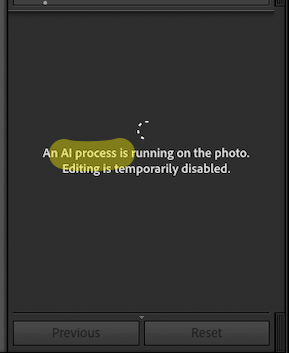
Denoising, to begin with, is very time-consuming. It messes with my workflow. (If I need to denoise a lot of photos, I suppose I can go rest on the couch and wait out my temporary disablement). But why? Because Denoising is done “as a service.” The AI is not on your machine, it’s on an Adobe server somewhere. So — I’m sure this oversimplifies, but I’m too lazy to understand how Lightroom moves data just now — Adobe makes you send a large RAW file over the Intertubes, wait for them to process itMR SUBLIMINAL And add it to their training sets and then wait for the same file to come back over those same Intertubes — free to Adobe, but not to you — where you can then open it and see what the results are. (Weirdly, Denoise applies only to the whole photo, and not to selections within it.)
Since the Denoise AI lives on Adobe’s server, you have no control over it, or understanding of what it does and how. Worse, the Denoise AI is part of (monopoly rentier) Adobe’s Software-as-a-Service business model, where if your subscription lapses, your ability to denoise photographs ends too. (Your photographs do not un-denoise themselves, though I’m sure Adobe would like to make that happen). Some clever Canadian should induce an extra-Imperial software firm to develop a Lightroom competitor where interoperable LLM models could be plugged in, locally, using a standard API. Imagine: You could actually own software, and the AI too.
Of course, I wouldn’t need to rely on denoising (whether by AI or manually) if I were a better photographer. So, again, if capital were under democratic control, I would vote against Software-as-a-Service, and for both becoming a better photographer, and for local and interoperable storage of denoising AIs.
NOTES
00See Cory Doctorow: “A ‘centaur’ is a human being who is assisted by a machine (a human head on a strong and tireless body). A reverse centaur is a machine that uses a human being as its assistant (a frail and vulnerable person being puppeteered by an uncaring, relentless machine).”
2 I might lose, since culturally, “we” value convenience above almost everything, but at least I would have voted. And campaigned.
3 Within my self-imposed parameters of handheld, as small an apeture as possible (big depth field fan here), and keeping ISO at 800 tops.
Comments
I was on Adobe Photoshop 12, part of the Creative Suite 5 Extended package (Illustrator, et al) and mulling updating to CS6 when they announced the new regime planned on moving to the cloud. So today, instead of parting with my hard earned coin for ever more minor incremental upgrades, I remain on my old version. Hard to argue it hasn’t been good for Adobe, however, as their stock has done nothing but go up ever since.
And on the AI front, I’ve found a few good uses on occasion. So there I was working on completing a website (https://audacitymodels.com for the curious) and struggling with my FAQ section. And it’s not that I haven’t heard everything under the sun in the 22 years since I founded the company, more like I was struggling to remember.
So I went to the chatGPT website and asked, what are the top 30 questions beginners to radio control model helicopters ask and instantly, I had a list to jog my memory. Of course I didn’t need help from that point forward and proceeded to put the list, plus other questions the assist had dislodged into a more useful order and complete my work (again, for the curious, https://audacitymodels.com/resources/faq).
Another instance is I like using sketches instead of people for some sections of my website, e.g. the Warranty, Shipping, Returns, the aforementioned FAQ, etc. Problem is artists can be sketchy themselves and getting ripped off gets old. And no, not usually for much money, maybe 50-75 bucks per drawing to work from my photo (which I took). What I am asking of them is to make a cartoon-like drawing of it.
Unfortunately, results can vary all over the map because everybody has their own style (and level of talent). So whomever does the work for me needs to be reliable so we do all the images on the site, else I get more than one style on the site and I don’t like that. So I went to a website that does sketches from photos using AI and presto, within a short interval I had my drawings — all in a consistent style.
Do I feel bad Adobe won’t get a monthly/yearly ‘subscription’ fee from me? Nope. Do I feel bad for artists who won’t get money from me, going forward? Nope, again! What about me? Do I feel bad I’m getting ripped off as my content — ‘my’ thoughts, ‘my’ words, ‘my’ work — gets ripped off by bots crawling my site to hoover up my content to feed to LLM (large language models) for the benefit of the AI outfits? Once again, no … because I’m not a hypocrite. After all, what’s sauce for the goose is sauce for the gander.
We’re in a new world, folks so you may as well enjoy the ride because complaining about it doesn’t matter!
—
John Beech
My wife feels strongly at AI is Satan for all the reasons, and doesn’t like me using it in any capacity, hoping to do our small part in starving the beast. But my rule for Generative AI is: if you like what you see/hear/etc., then it’s fine (emphasis on actually interacting with the results).
I fall back on the graphic design world when laser printers first appeared and the jobs of film strippers (print industry) disappeared: any office worker suddenly had the power to create a pamphlet and print it out — it might be ugly and ineffective, but if the boss liked it, good enough! (for them) ship it! At least an office worker had to create or assemble it, so it was to a great degree a reflection of their work. The difference that a professional graphic designer, copywriter, or tech writer could achieve was orders of magnitude better than joe-once-a-year-pamphlet-nerd. But the world was prepared to drop, not just the expense, but betterness of it, in a heart beat.
Same-same with generative AI, only now people don’t even have to put the work in; many AI users don’t proof, don’t review, tweak, question, or even read before sending; we read their generated slop daily. Once again, in a heartbeat, the world is prepared to drop the expense, but now more crucially drop the accuracy & correctness.
Which is a shame, because retail Generative AI, as far as it goes, is pretty incredible. You can converse with it, take what works, discard what doesn’t; bounce ideas off it if you think you’re getting anything of value back. It really shines as a pocket calculator for thought and imagery as long as the limitations are apparent and appropriate to the task at hand. But maybe the same could be said of Satan (who might also be more convenient to use than google image search).
John Beech and Yahmaybeno have both provided use cases for AI. I am not convinced. I suggest that the cons far outweigh the pros. The main con being the massive energy and water waste. And since this technology is not doing anything that we cannot do for ourselves, why on earth would we waste energy and water in the name of our convenience?. There are too many people without work now, I cannot be in favor of a technology that will make that worse. Ditto for wealth inequality in the world, AI is only making the wealthy few even wealthier. Our brain is a muscle, it needs to be exercised in order to work. Thinking, reasoning, and problem solving are good for us — whether it is writing a simple email, creating an image, solving a math equation, coding, driving a car, whatever else AI is doing for us, we’d all be much better off if we did these things for ourselves, so would the planet.
I failed to acknowledge our host’s pain re Adobe. I understand that needs must and I feel lucky to be retired and able to refuse use AI in my life. I chose a daily walk, gardening, crochet and learning to paint and draw to replace my 8 hours per day of working for the man. YouTube is a help in learning my new hobbies but even there I can avoid the AI slop and seek the human created content.
Cory Doctorow makes this distinction:
Start with labour: in automation theory, a centaur is a person who chooses to use technology to help them do the things that matter to them. A reverse centaur is a person who has been conscripted to serve as a helper for a machine, at an inhuman, machine pace: a driver made to deliver all day long, nonstop; a warehouse worker made to work without food or bathroom breaks; a programmer made to crank out impossible amounts of code. As Doctorow says: it’s not enough to ask what the technology does – we have to understand who it’s doing it for and who it’s doing it to.
Both John Beech and I are centaurs. I would argue that the vast majority of AI users are in fact reverse centaurs; it’s forced on them in the workplace, or they are incentives to use tokens, etc.
The question of whether AI is useful to society at large is quite different from the question of whether it’s good for me (or my small business). I’m with CanCyn above in that I doubt very, very much what AI will net out positive in that sense, if for no other reason that the people who own it have interests antithetical to most of us.
Further to Adobe