
On this day (1873): Heinrich Schliemann discovers ‘Priam’s Treasure’, a cache of gold and other objects in Hisarlik (Troy) in Anatolia.
Deal. From my OED app: “/diːl / ▸ verb (past and past participle dealt /dɛlt /) 1 [with object] distribute (cards) in an orderly rotation to players for a game or round: the cards were dealt for the last hand [with two objects] fate dealt her a different hand figurative [no object] he shuffled and dealt. ▪ (deal someone in) include a new player in a card game by giving them cards. ▪ distribute or mete out (something) to a person or group: strict sentences were dealt out to the defendants. 2 [no object] take part in commercial trading of a particular commodity: directors were prohibited from dealing in the company’s shares. ▪ be concerned with: journalism that deals in small-town chit-chat. ▪ informal buy and sell illegal drugs: you are suspected of dealing in drugs [with object] many of the men are dealing drugs. 3 (deal with) [no object] take measures concerning (someone or something), especially with the intention of putting something right: they seem incapable of dealing with the problem. ▪ cope with or control (a difficult person or situation): you’ll have to find a way of dealing with those feelings. ▪ [with adverbial] treat (someone) in a particular way: life had dealt very harshly with her. ▪ have commercial relations with: the bank deals directly with the private sector. ▪ have as a subject; discuss: the novel deals with several different topics. 4 [with two objects] inflict (a blow) on (someone or something): hopes of an economic recovery were dealt another blow. ▸ noun 1 an agreement entered into by two or more parties for their mutual benefit, especially in a business or political context: the government was ready to do a deal with the opposition. ▪ [with adjective] a particular form of treatment given or received: working mothers get a bad deal. ▪ (the deal) informal the situation or state of affairs: what’s the deal with you and that guy?; big double standards exist, but he knows the deal. 2 [in singular] the process of distributing the cards to players in a card game: after the deal, players A and B stay out. ▪ a player’s turn to distribute cards: ‘Time for one more game.’ ‘All right. Whose deal?’. ▪ the round of play following a distribution of cards. ▪ the set of hands dealt to the players. – ORIGIN Old English dǣlan ‘divide’, ‘participate’, of Germanic origin; related to Dutch deel and German Teil ‘part’ (noun), also to dole1. The sense ‘divide’ gave rise to ‘distribute’, hence deal (sense 1 of the verb)1 deal (sense 4 of the verb)1; the sense ‘participate’ gave rise to ‘have dealings with’, hence deal (sense 2 of the verb)1 deal (sense 3 of the verb).” • Many distributaries from the OE root!
“China says deal to end Iran war will be submitted to UN Security Council for endorsement” [Anadolu Agency]. “Chinese Foreign Minister Wang Yi said Tuesday that Beijing believes an agreement to end the US-Israeli war against Iran will be submitted to the UN Security Council for endorsement. Officials in the US and beyond have been cautiously optimistic about progress made toward finalizing the pact, and Wang said Beijing hopes ‘the parties concerned can stay committed to pursuing a ceasefire, and can continue to meet each other halfway so that peace can return to the Middle East as early as possible.’” And: “ ‘We believe that once an agreement is reached, it will be submitted to the UN Security Council for endorsement for it to have legitimacy and authority,’ he said in remarks translated from Mandarin delivered at the UN’s New York headquarters.” • “Deal” is in the headline, presumably because it’s shorter, but “agreement” is in the text, throughout (meaning that Anadolu Agency has a good copy editor.) The two are not synonyms: Deals do not have “legitimacy and authority,” for example. (Substituting “deal” for “agreement” is part of a general homogenization/sloppification of words denoting ruling class activities and entities. We have “leader”, for example, substituting for President, CEO, Department Chair, coach, rector etc. These words are not synonyms because they have different institutional contexts (that is, “fields,” and thus different powers, forms of social and symbolic capital, etc.).
“Why Trump is using Iran talks to revive the Abraham Accords” [Middle East Eye]. “President Donald Trump’s injection of the Abraham Accords into talks with Iran underscores how the Islamic Republic is getting the better of the US at the negotiating table, and Trump is trying to distract from it, current and former US and Arab officials told Middle East Eye. ‘Trump knows he’s getting a deal that undermines every war aim he espoused after 28 February. So, he’s trying to create a bigger deal,’ Aaron David Miller, a former Middle East negotiator, told Middle East Eye. ‘This is a typical Trump ploy,” added Miller, now a senior fellow at the Carnegie Endowment for International Peace. The deal under discussion would extend the shaky ceasefire in place now for 60 days. In exchange for obtaining a sanctions waiver on oil sales, Iran would reopen the Strait of Hormuz, where the US also has a competing naval blockade. The deal does not address Iran’s ballistic missile arsenal, which The New York Times has reported is at 70 percent pre-war levels.” • A Martingale strategy?
“Joe Rogan goes ballistic on Trump over IRS settlement and $1.8 BILLION ‘slush fund’ ” [Daily Mail]. “Rogan was apoplectic, particularly about the extraordinary side deal granting Trump and his sons immunity from IRS tax audits…. The comic kept repeating that the deal was ‘crazy’ throughout the program.” And: “ ‘Do you really think that the American people like the president suing himself, basically, then making a deal that benefits himself with a broad immunity, for not just for IRS dealings but anything else?’ said outgoing Louisiana Senator Bill Cassidy.” • Musical interlude:
For my sins, I got on Domino’s mailing list:
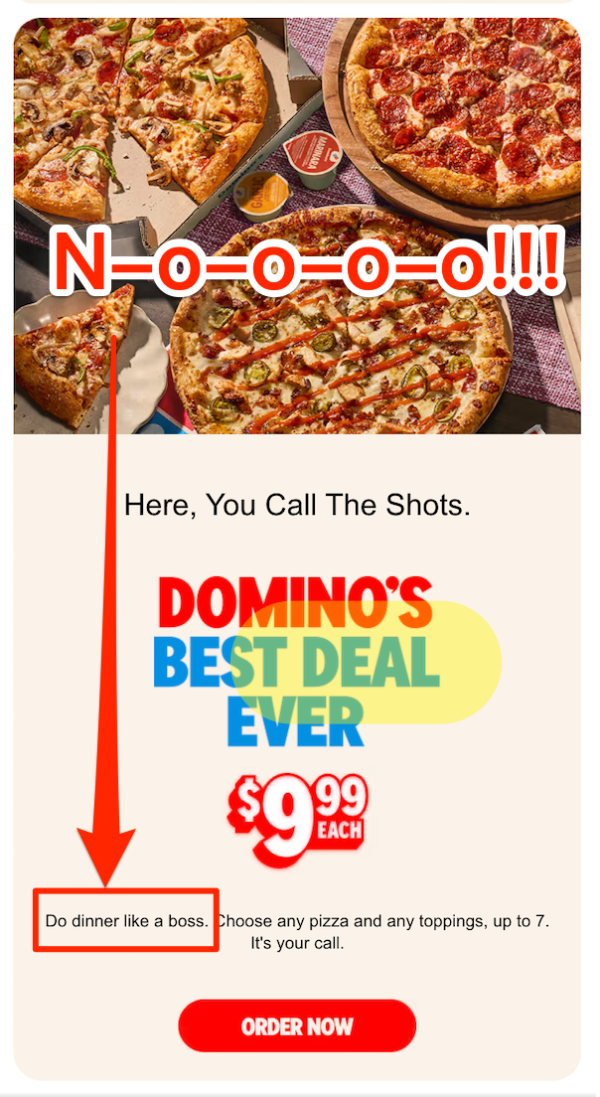
But I seriously doubt that the boss, or anyone “like” a boss, is eating at Domino’s.
Dad Joke of the Day: My wife asked if I’d seen the dog bowl I said I never knew he did.
Optimize. From my OED app: “/ˈɒptɪmʌɪz / (British English also optimise) ▸ verb [with object] make the best or most effective use of (a situation or resource): we manage our time so that we optimize our productivity. ▪ Computing rearrange or rewrite (data, software, etc.) to improve efficiency of retrieval or processing. – ORIGIN early 19th century: from Latin optimus ‘best’ + -ize.”
“The New Counterculture” [The Honest Broker]. “The whole corruption of aesthetic language is the application of financial jargon to artistic creativity. This is why instead of calling a work of art by its real name, we call it content. This is why we call a movie a brand franchise. This is why the head of the big AI music company talks about the productivity of being able to release 100 tracks in a week. These are all words—this jargon, this terminology—that come from the business world. It has no place in the creative world. But it’s become so pervasive that even artists begin to talk about their own work as content. This is something that is only happening because we have replaced a tradition where you have a person who has values and applies those values. We’ve replaced that with a business/finance optimization mindset across the creative economy.” More: “There is a counterculture out there, but it’s struggling now because it is starved of cash. The media often operates on advertising, but two companies control 60% of the ad money online. It’s Alphabet and Meta. So basically, two companies control that.The other way is to get your name out through social media. But two billionaires control social media. It’s the same consolidation on the institutional side that we saw on the creative side. I really think there are about 50 people who control the culture now, which is frightening. Go back a generation. Tom Wolfe made an amazing claim. He said the art world is controlled by 3,000 people. Now what did he mean by that? Well, he’s talking about painters, sculptors, and he says that these 3,000 people decide who’s hot and who’s not. Now 3,000 people, that didn’t seem like much, but that would be great compared to what we have now.” • And then, I hope, there’s blogging; see here and here.
“How Palantir is becoming embedded in major newsroom operations” [Middle East Eye]. “In May 2024 – several months after Palantir announced its strategic defence partnership with Israel – [Swiss publisher Ringier, which owns dozens of media and entertainment brands across Europe and Africa] published its 2023 annual report, revealing that it had also begun using Palantir’s Artificial Intelligence Platform (AIP) as part of a five-year partnership with the company. According to the report, AIP helps Ringier ‘improve relevant content and better understand user preferences’ by integrating and processing large volumes of data. The technology also enables the ‘precise targeting and optimization of advertising strategies.” More: “Ringier does not only use Palantir’s technology, it has also hired its own in-house Palantir expert.’” • Swell.
“The Compiler Doesn’t Care How Clever Your Code Is” [Silicon Opera]. “Clever code is a liability dressed up as a virtue. The programmer who writes it is optimizing for the wrong audience: themselves, at the moment of writing, in the particular mental state that made the cleverness legible. Everyone who comes after, including that same programmer six months later, is on their own. This is not an abstract complaint. It is a structural problem in how software teams accumulate debt, lose velocity, and eventually watch good engineers quit in frustration. The cult of cleverness has real costs, and the industry has been slow to reckon with them honestly.” And: “Google’s internal research on code review (documented in their engineering practices publications) consistently finds that code clarity is the single biggest factor in review speed. Code that requires multiple back-and-forth exchanges to understand costs multiples of what clear code costs. The time lost is invisible on any individual PR and catastrophic in aggregate.” • Good think AI vibe code is so clear and legible. Oh, wait….
Fortune: “A likely impossibility is always preferable to an unconvincing possibility.” —Aristotle
Offline. From my OED app: “/ɒfˈlʌɪn / ▸ adjective (of an activity or service) not available on or performed using the internet or other computer network: schools in the state will resume offline classes from November; the offline business is rapidly expanding. ▪ not controlled by or connected to a computer or the internet: the social media network is offline, taking major services with it. ▸ adverb 1 not by means of the internet or other computer network: candidates are required to submit the assignments either online or offline. ▪ while not directly controlled by or connected to a computer or the internet: download playlists to listen to offline. ▪ with a delay between the production of computer data and its processing. 2 out of operation or existence: all but one of the current power stations are due to go offline within the next decade; three-quarters of Gulf of Mexico oil production remains offline ; it has taken one of its generators offline for maintenance.
“Humanity Needs to Get Offline” [Matt Taibbi, Racket News]. “Having been off the Internet for a bit (thanks for your patience again, Racket, I’m back to work) it’s been remarkable to peek and see how much existential terror about basic life issues is pouring online. There’s been a steady up-tick in op-eds in search of solutions to aging and death and increasingly fraught interviews with ‘experts’ about what to do about everything from a worldwide decline in fertility rates to disillusionment with the ‘myth of marriage’ to the benefits of ‘assortative mating.’” At least in terms of the media coverage, it’s probably ruliing class angst bleeding downward (the only trickle down theory that works). I mean, if you just lost your job to AI, you’re worries are on a spectrum from failing to make your mortgage payment to not eating. Solutions to aging and death will not be top of mind for you. More: “Human beings are reproducing less, learning less, are more ambivalent about everything from having sex to starting families to pet ownership, and seem to have fewer tools than ever for dealing with big life questions, beyond panic-Googling in search of new products or scientific advice. The most obvious answer to a long list anxieties is to get offline, but it’s ignored, purposefully….” • at which point we get the Substack offer “continue reading this post for free,” which is a lie, because the price is polluting your device with yet another app, which is really doing gawd knows what.
“Building stdnotes” [Nrird]. “Most note apps are cloud-first. Your notes don’t exist until they’re on a server. If you’re on a plane, in a basement, or behind a corporate proxy, you’re blocked. And every one of them requires an account before you can type a single character. I wanted to flip this: start offline by default, opt into the cloud later.” • Holy moley, kids these days. Putting your data in the Cloud is the default, not local storage? Actually owning your data is something people cheerfully bypass? And it takes an original thinker to notice this?
“the motel room, or: on datedness” [McMansion Hell (2024)]. “To find what one is looking for online, one must game the search engine with filters that only show content predating 2021, or, even better, use existing resources (or those previously discovered) both online and in print. In the physical world of interiors, to find what one is looking for one must also now lurk around obscure places, and often outside the realm of the domestic which is so beholden to and cursed by the churn of fashion and the logic of speculation. Our open world is rapidly closing, while, paradoxically, remaining ostensibly open. It’s true, I can open Zillow. I can still search. In the curated, aggregated realm, it is becoming harder and harder to find, and ultimately, to look.” And: “But what if, despite all these changes, datedness was never really searchable? This is a strange symmetry, one could say an obscurity, between interiors and online. It is perhaps unintentional, and it lurks in the places where searching doesn’t work, one because no one is searching there, or two, because an aesthetic, for all our cataloguing, curation, aggregation, hoarding, is not inherently indexable and even if it was, there are vasts swaths of the internet and the world that are not categorized via certain - or any - parameters. The internet curator’s job is to find them and aggregate them, but it becomes harder and harder to do. They can only be stumbled upon or known in an outside, offline, historical or situational way. If to index, to aggregate, is, or at least was for the last 30 years, to profit (whether monetarily or in likes), then to be dated, in many respects, is the aesthetic manifestation of barely breaking even. Of not starting, preserving, or reinventing but just doing a job.” • Hence, or not, dark forests?