
Don’t Miss These
(1) Festival of Platner: “I know firsthand why Graham Platner shouldn’t be a U.S. senator” • WaPo, not paywalled.
(2) “Palantir’s kill chain meets the multipolar child” • Billionaires don’t want to “stay in their lane.”
(3) “Andrew Tate’s Empire of Abuse” • Truly vile.
(4) “You Can Now Get a Religious Exemption From Using AI at Work” • Unitarians rejoice!
Birdsong of the Day
Moar mimidae:
Road Along E Bound. Of Summit Golf Course, Richmond Hill, Ontario, Canada (1953). “Singing from birch and 2 other perches along hedgy roadside Also heard: generator hum, lambs in last section.” The LMS numbers at the beginning are a highlight, along with the lambs.
“Birds That Look Like They Were Designed by a Committee” [10,000 Birds]. “Greater Racket-tailed Drongo: A sensibly designed glossy passerine – until the tail department provided its input’:

Politics
Festival of Platner
“Platner Jabs Trump as ‘Dumb,’ Quips Imprisoning Billionaires Would Fix Campaign Finance” [KTSA]. “ ‘We need to get money out of politics. We need to get rid of Citizens United. And, if I had my way, elections would last two months, they will be publicly funded and if a billionaire looked at a TV ad the wrong way, we’d put ‘em in jail,’ Platner told a crowd of constituents Sunday night in Maine, earning applause.”
The Locals:
“Graham Platner should make combatting violence against women a priority” [Opinion Contributor, Bangor Daily News] • Does “Opinion Contributor” really believe that the The Epstein Class — oligarchs — don’t perpetrate violence against women, personally? Or that oligarchy doesn’t create conditions that damage and kill women? (This is a reader-contributed section.)
“Maine Democrats speak cautiously about Graham Platner ahead of Tuesday’s primary” [Bangor Daily News]. “Platner’s campaign points to a string of news stories highlighting voters sticking with him. Platner says his private life has been ‘weaponized’ while Collins’ public actions have received little scrutiny. His campaign says it recorded its biggest fundraising day since Mills dropped out in the 24 hours following Thursday’s New York Times’ report on his relationships.” • Maybe.
“Some Maine Democrats are wavering on Graham Platner” [Politico]. “ ‘I want someone of good moral character to be my senator,’ he said, describing himself as 50-50 on the race right now.” • As I wrote, here’s list of bullet points showing what the Democrat Party supports:
- Genocide
- Oligarchs
- Nazis
- Spooks
- Gerontocracy
- Systematically Concealing A President’s Cognitive Impairment
- Allowing a Cognitively Impaired President To Appoint His Putative Successor
- Steve Israel
- #MeToo-style Workplace Abuse by a Respected Party Elder
- Having Nothing to Say to the Working Class
(I should have put oligarchs first, because they drive everything. Does anybody of “good moral character” support genocide?
The Beltway:
“I know firsthand why Graham Platner shouldn’t be a U.S. senator” [Genevieve McDonald, WaPo]. One of the interesting things about McDonald — aside from her reported conflicts of interestMR SUBLIMINAL Never a problem for Democrats (here’s another one)— is that she was a lobster boat captain, in Stonington, on the opposite side of Mount Desert Island from Platner, in Sorrento. So, they have similar stories to tell. It would be irresponsible not to speculate that McDonald, four years a State representative and wired into Maine NGOs, had her eye on the seat that Platner is running for, even though he must be, in her mind, far less deserving of office than she is, and that she’s hoping to boomerang her way back into prominence in the party with Op-Eds like this, which for some reason WaPo has not paywalled. I have helpfully interwoven comments:
“Then, I [McDonald] began receiving calls from Washington warning me he was not who he seemed: ‘Have you read his oppo file?’” Wait. Where did that file come from? Collins? Schumer? Mills? More: “I had not. I trusted that his out-of-state consulting team had thoroughly vetted him.” Frankly, that doesn’t speak well of Platner. Not only did he hire a potential competitor, his campaign manager had no notion of what due diligence was. More: “Despite being exposed by a series of scandals beginning last October, he kept assuring voters and the Democratic Party that there were no more skeletons in his closet. Then more emerged.” Emerged is rich; I’ve helpfully underlined the passive voice where McDonald evades responsibility for her actions; they “emerged” because she violated the confidence of Platner’s wife in order to leak them. More: “His wife, Amy Gertner, had made the campaign aware of the problem before Labor Day.” More evasion. McDonald personally was made aware, not “the campaign.” More: “I was one of the Platner campaign’s first gaslighting casualties.” Dear Lord. More: “As scrutiny of Platner continued to heat up after my departure, the campaign offered me $15,000 to sign a nondisclosure agreement. I refused.” The NDA was very stupid, besides being wrong. More: “Democrats are being sold a narrative that Platner is the only choice for the race against Republican Sen. Susan Collins. Maine voters don’t have to accept that. There are two other named candidates on Tuesday’s ballot. If Platner wins the nomination but later withdraws, Maine Democrats can hold a convention and choose a different nominee. The answer to a broken political culture is not to accept it. Demand better from those entrusted with power or seeking it. Enough is enough.”• The thing that really bugs me is that McDonald’s betrayal and the ensuing dogpile is also an assault on a woman: Amy Gertner, and her marriage to Platner (since they worked through these issues together, and went for counseling, very much unlike the Clintons, respected party elders still). Enough Democrat moralizing. See the bullet points above.
“Disqualify Spencer Pratt” [Brian Beutler, Off Message]. “Indeed, every blue state should advance legislation to penalize election lying, with the goal of taking the idea federal in 2029. This would both represent a proportionate response to Donald Trump’s corrosive lying and help Democrats rehabilitate their national image, which has never been more tattered.” • Would this be retroactive? I well remember [genuflects] Obama in 2008 promising to filibuster a bill to retroactively legalize Bush’s felonious program of warrantless surveillance. After he was nominated, he went back on his word. Here’s another idea: Why don’t we claw back all campaign contributions to Democrats who vote for genocide?
“The easy part’s over for Platner” [Politico]. “[T]he controversies that defined much of his campaign are here to stay as Platner faces fury in his own party and the Republican campaign juggernaut in what promises to be a buzzsaw of a general election matchup. Playbook has a first look at what to expect from the Collins-aligned Pine Tree Results PAC’s next seven-figure general election ad buy, set to be rolled out later this week (they’ve spent roughly $4 million already). The first one — ‘Read the Posts’ features Maine voters reading Platner’s controversial Reddit posts. Platner says ‘cops are bastards — all of them,’ a man wearing a State Police polo says. ‘Graham Platner has no respect for law enforcement.’ ‘I would never vote for Graham Platner,’ a woman in her kitchen says. ‘Graham Platner: Too Risky for Maine,’ reads the final text of the ad over the now notorious video of Platner with his Totenkopf. ‘He’s an awful person,’ a woman in a kitchen says in a second ad resembling one Democratic Gov. Janet Mills deployed against Platner in the primary. A source familiar with Pine Tree Results’ strategy said the ads will air throughout the summer.” • I wonder, though, if Platner has innoculated himself against big media buys with his town halls.
* * * “Graham Platner, amid controversies, looks to advance in Maine Democratic Senate primary” [ABC News]. “Throughout the campaign cycle, polling has found that most likely primary voters view Platner positively. The University of New Hampshire poll, which published shortly before the most recent reports on Platner, found that 76% of likely voters planned on ranking Platner, a progressive who has focused on wealth inequality, first on their ballots, which have ranked choice voting. Given Maine’s system of ranked choice voting and having local municipalities — not the state government — be responsible for counting the ballots on election night, it remains unclear how long it will take for each race to be called.” • Voters in the general may be different, of course. But voting to kick over the rigged game’s table, which is what a vote for Platner is, isn’t confined to Democrats.
Trump Administration
“The $8 Billion Reason James Dolan Invited Trump to the NBA Finals” [The KOT Show]. “James Dolan owns the Knicks and Madison Square Garden. Dolan’s been a financial ally and personal friend of Donald Trump for decades. Dolan got married at Mar-a-Lago in 2002, with Trump among the 400 guests. He’s donated $100,000s to Trump-aligned political vehicles. When facing a public-relations crisis over his use of facial-recognition technology to bar attorneys from MSG who had sued him, Dolan hired Hope Hicks, the former Trump communications director, as a consultant.” More: “The fans feeling this most are the ones spending $9,000 on the cheapest resale seats, or who bought playoff tickets months ago and received notices that a ‘strict no-bag policy will be in effect.’ They will ‘expect enhanced security measures including TSA-style screening procedures.’” And now: “As far back as September 2025, a delegation of Trump supporters met at the White House and floated a proposal to rebuild Penn Station and relocate MSG — but only if Dolan agreed. He didn’t. … Then, on May 20, the Trump administration announced its decision. The federal government committed $8 billion to overhaul Penn Station…. The plan keeps MSG exactly where it is. A competing bid from Grand Penn Partners, backed by Trump ally and GOP mega-donor Tom Klingenstein, had proposed moving the arena across Seventh Avenue. That plan was rejected. Dolan got what he wanted. By the time James Dolan invited Donald Trump to sit in his suite at the NBA Finals, the $8 billion question had already been answered in Dolan’s favor. This wasn’t ongoing lobbying. This invite was a thank-you. Or a victory lap. Depending on which man you ask. When [NBA Commissioner Adam Silver] talks about basketball being a ‘unifying’ force, this is what he means. As George Carlin said, ‘It’s a big club, and you ain’t in it.’” • It’s quite a small club, actually.
“Trump booed before Knicks lose to Spurs at Madison Square Garden in NBA Finals Game 3” [CNBC]. “A native of Queens, New York, who first gained fame as a brash Manhattan real estate developer, Trump is now deeply unpopular in heavily Democratic New York City.” More: “Trump’s presence at the game caused waits of two hours or more for ticket-holding fans to enter the famed arena in Midtown Manhattan after security screening.” And: “That unhappiness grew when game watch parties in the area around MSG were canceled because of Trump’s presence, and the New York Police Department set up a broad security perimeter in the surrounding blocks.” •
Geopolitics
“An Insurance War Without Borders” [Global Finance]. “The Iran war exposed something corporate finance teams are newly realizing about their insurance policies: what they think is covered might not be. Surprises are showing up across boardrooms in Houston, London, Singapore, and anywhere else that depends on energy, international freight, or global supply chains.” And: “What makes the latest Persian Gulf conflict difficult to model is that countries central to the war present different coverage landscapes. In Israel, with its state-owned Inbal Insurance Company, much of the property damage and business disruption is absorbed by government mechanisms, which is why the private insurance loss estimates, while significant, look modest relative to actual damage. Iran is a different story, and the reason is sanctions, Wilde says. ‘Even if a claim is facially valid and the policy clearly covers the loss, OFAC [Office of Foreign Asset Controls] regulations and EU sanctions rules can prohibit the actual transfer of claim proceeds if any party in the transaction chain has a nexus to a sanctioned person or jurisdiction,’ he says. Global insurers aren’t covering Iranian assets because they legally cannot; the risk sits with the Iranian state and whatever domestic mechanisms exist, which are limited by the same sanctions that keep Western capital out.Lebanon may be the most exposed.” And: “Collectively, the situations for insurers in Israel, Iran, and Lebanon highlight a disconnect. Today’s standard commercial insurance policies were written for an era when ‘war’ had a different definition: armies understood battlefields, declarations of war, identifiable states. Modern conflict doesn’t look like that. ‘Companies are discovering too late that their policies don’t map onto modern hybrid-warfare scenarios,’ observes Wilde. Drone strikes, missile attacks, government-ordered port closures, Houthi interdiction of commercial vessels are all events that carriers increasingly classify as ‘acts of war’ and exclude from standard commercial coverage.”
“Hormuz Gauntlet Runner Says Trump Has Been Good for Shipping” [SupplyChainBrain]. “Dynacom Tankers Management, one of the few oil tanker owners to have braved the Strait of Hormuz during the Iran war, said U.S. President Donald Trump has been a good news for shipping. ‘Trump is doing his best for the world but in parallel he’s doing the best for shipping,’ George Procopiou, the company’s founder, said during rare public comments on June 1 at the Capital Link Maritime Leaders Summit in Athens….At one stage shortly after the war started, day rates for tankers exceeded $600,000 a day — many multiples above peace time levels — according to the Baltic Exchange in London. The surge boosted profits for shipping companies but simultaneously drove up transport costs across the oil industry. While other owners balked at sending their tankers through the waterway because of the threat from Iran’s military, Dynacom caught the market’s attention by continuing to do so.” • Ka-ching!
“Palantir’s kill chain meets the multipolar child” [The Cradle]. “By 9 April, US Central Command (CENTCOM) had reported more than 13,000 strikes against Iranian targets, with 1,000 hit on the opening day alone. The platform doing the work was Palantir’s Maven Smart System, which fused satellite imagery, drone footage, and signals intelligence to ‘identify, prioritize and recommend strike packages against Iranian military sites, nuclear facilities and leadership targets.’… Maven generated more than 3,000 targeting options against Iran in 24 hours during the opening phase. Kill-chain expert Craig Jones told Vision of Humanity that the system had compressed targeting decisions to a tempo ‘much quicker in some ways than the speed of thought.’…. Maven’s target classification accuracy hovered around 60 percent, against 84 percent for trained human analysts. The Shajareh Tayyebeh Primary School in Minab was struck during the same campaign. It killed at least 175 people, most of them schoolgirls between the ages of seven and 12.” • 60% accuracy is better than a coin flip, I suppose. And anybody who doesn’t think this technology won’t be deployed domestically should think again. And while all this was going on, Palantir CEO Alex Karp released his 22-point manifesto (the best part: “The culture almost snickers at Musk’s interest in grand narrative, as if billionaires ought to simply stay in their lane of enriching themselves.” I don’t know what this entity, “the culture,” might be, but it was clearly wounded Karp’s amour propre deeply. And yes, billionionaires should stay in their lane. Until they come to the first exit.
Business Sentiment
Today’s Fear & Greed Index: 43 Neutral (previous close: 40 Fear) [CNN]. One week ago: 56 (Greed). (0 is Extreme Fear; 100 is Extreme Greed). • Still swooning, but now lying flat.
Business: AI
“AI Is Slowing Down” [Ed Zitron, Where’s Your Ed At?] “Whatever obtuse fantasies you have about the current state of generative AI are irrelevant to a much larger problem: that the infrastructure being built and compute commitments being made are being done so at a level that demands that generative AI and AI compute generate over $2 trillion in annual revenue by 2030. When I say that, I mean it absolutely has to do that otherwise none of the data center capex makes sense, and neither Anthropic nor OpenAI can pay their commitments.” But: “Between them, Anthropic and OpenAI represent the vast majority of all AI compute demand — at a minimum 70%, if not 80% to 90%. Put another way, there’s barely a few billion dollars of demand outside of two companies that lose billions — or tens of billions — of dollars a year.” • Hmm.
“AI: just one big trade” [The Next Recession]. “AI is one big trade for the US stock market investors and one big bet on the US economy. That’s because the amount of capital investment being made by the companies called the ‘hyperscalers’ into AI models, data centres and other AI equipment is staggering. As a share of US GDP, it is now set to far surpass the 19th-century railroad build-out.” More: “The hyperscalers Microsoft, Alphabet, Amazon, Meta and Oracle plan to invest hundreds of billions in the next five years in data centres to provide the computing power to run these AI models. Capital investments are expected to rise by 20 per cent a year, a growth rate never seen before in this industry.” More: “US GDP growth is now driven almost exclusively by rising tech spending. If this starts to drop, the US economy will enter recession very quickly — even if tech investments decline only by a little bit, say 4 to 6 per cent, as happened after much smaller tech booms in the 1960s and during the 2009 recession.” And: “The risk, then, is that the economy, the profit cycle and the stock market ‘are all leaning on the same narrow pillar. If the expected returns on AI infrastructure and platforms are questioned, the fallout may not stop at a few richly valued technology stocks.’” • And when the trees stop grpwing to the sky?
“AI Just Isn’t Right” [Wired]. “Over the past year or so, more and more people have looked at me with great pity. Surely a fact-checker at a magazine isn’t long for this AI-upgraded world. Call me foolish, but I’m not that worried. Very little of humanity’s collective knowledge, I’ve concluded, lives on the internet. And according to my research, AI is even more wrong than people might think.” More: “In any article that comes across WIRED’s fact-checking desk, there’s usually a decent amount of “b-matter”: statistics, news events, quotes, anything that helps contextualize the topic. Fact-checkers tend to Google this basic information, and that process, in the form of the search engine’s dreaded AI Overviews, constitutes my main interaction with AI. In my professional opinion, it’s unusable—wrong—about a third of the time.” Not only wrong, but wretchedly sourced. More: “Once we get past the googleable b-matter, my job really gets fun. It’s why I still get a thrill when I find some bit of information that doesn’t exist on the internet—a particular sign at a border crossing, the rates of kelp growth in two different climates, whether or not there was a Burger King at a particular LA intersection in 1979. AI systems can’t stay on the phone with a widow for over an hour because asking difficult questions turned on a fountain of grief that needed care and human receptivity. It can’t suss out that there’s beef between two sources which may be blurring the edges of what counts as ‘factual.’ It can’t tell that an email with the phrase ‘Thanks for your email!; may, perhaps, be passively hostile. Most physical media in the world remains offline.” • All true. Of course, it sounds like the author has a very good editor and works for a top-notch publication. Corporate — or a private equity buyer — might do away with fact checkers tomorrow.
“You Can Now Get a Religious Exemption From Using AI at Work” [Futurism]. “[A] 34-year-old software engineer named Erin Maus, who works for a tech entertainment company in North Carolina, may have found an ingenious workaround. As Business Insider reports, Maus has secured a religious exemption effectively allowing her to skip using AI for her work. Maus is a Unitarian Universalist, a pluralistic religion that’s rooted in the inherent worth of every person. In April, she argued that AI didn’t align with her religious beliefs, citing environmental and ethical concerns. In mid-May, her employer granted her the unusual accommodation. ‘I’m writing my code and reviewing my code by hand, which seems crazy to say,” she told BI. “Just two years ago, how else would you do it?’” • Nothing to do with Pope Leo. Unitarian Universalist doctrine is about as far from Catholicism as you can get.
” Casting Director Scam Is Sweeping Through Hollywood” [Hollywood Reporter]. “Like so many others, Isabella Schaub moved to New York with a dream. With ambitions to act, the recent college grad, a 24-year-old with a pale, heart-shaped face and curly auburn hair, started doing background work on film and TV in between barista shifts and coaching soccer, among other gigs. And in February, she got a massive break, especially for one so young and new to the game: A major Hollywood casting director [Linda Lowy] got in touch.” But oh no: “Given the project, Schaub was required to sign an NDA, which was no issue. There was only one hitch: She needed to become a member of the performers union, SAG-AFTRA, to play the role. Fortunately, Lowy was able to connect Schaub with a union contract administrator. But that admin didn’t have an official SAG-AFTRA email address (his was “SAG-AFTRA [at] contractor.net (SAG-AFTRA[at]contractor[dot]net)”). When Schaub Googled him, she couldn’t find someone with that name at the union. Finally, Schaub contacted the union through official channels. ‘Yeah, that’s fake,’ she remembers a real SAG-AFTRA rep telling her. After that, she heard back from the supposed union admin: Initiation fees of $3,000 could be paid through bank transfer, PayPal or CashApp.” • Rather like Andrew Tate (below) though on a far less vicious scale. And do note the good guys here: SAG-AFTRA.
“AI and the Pitfalls of Innovation” [Paul Krugman]. “Today’s primer will be the first of what I expect to be a multi-part series on the economics of AI. Today I will focus on the history of productivity, while reserving extended discussion of AI’s future, fears of technological unemployment, effects on income distribution and more for subsequent posts. Beyond the paywall I will address the following….” • So at last Krugman is dipping a running shoe into the pool. It will be interesting to see what Doctorow and Zitron, who have been toiling in the AI vineyard far longer than Krugman, have to say about this views.
Business: Media
“Do links hurt news publishers on Twitter? Our analysis suggests yes” [Neiman Lab]. “our new analysis of thousands of tweets from 18 publishers makes it pretty clear: Links do seem to hurt news publishers on X/Twitter.” And: “Links are not the only thing keeping big news publisher from high engagement on tweets; there are lots of factors. But this analysis shows that the way that most big news publishers, with the exception of Fox News, really haven’t changed the way they tweet, even as the platform’s incentives have changed.” • Nuts. Without links, there’s no way (easily) of assessing claims. Perhaps that’s Elon’s goal (that, and a walled garden of slop).
“Social media has become a freak show” [Nate Silver, Silver Bulletin]. “Here, voilà, are the Twitter accounts with the most engagement so far in 2026”:
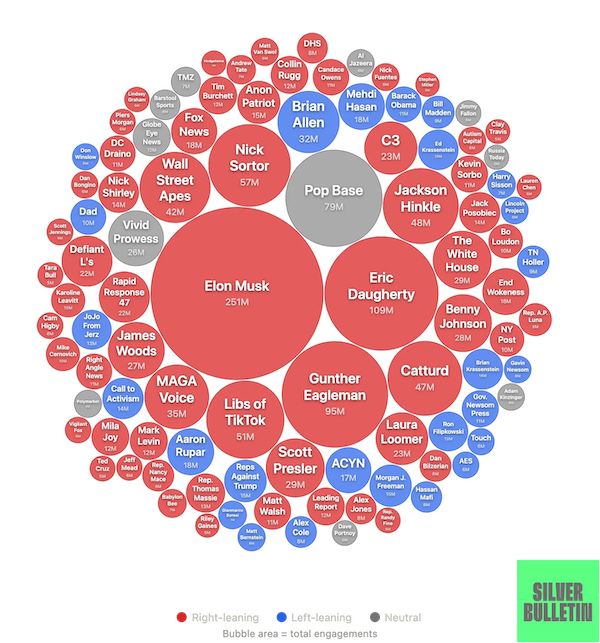
• Jackson Hinkle?
Business: Shipping
“PepsiCo is running 35 driverless trucks on Arizona roads, making it the first major U.S. consumer-goods company to disclose the real-life, large-scale use of autonomous trucks on public roads” [Wall Street Journal Logistics Report]. “[T]he trucks traverse busy highways and local streets transporting snacks and drinks between bottling plants, storage facilities and stores such as Walmart and Dollar General. While at least nine autonomous-truck companies operate in Southern and South-Central states, many still have human monitors at the wheel, or are only used in limited tests. PepsiCo, using trucks outfitted with sensors and other tech from Gatik, has taken the use of the vehicles a step beyond.”• 35 is not very many. Are the roads in Arizona especially grid-like?
Photo Book
Something to be said for black-and-white:
Today’s Feature: Andre Kertesz
Street Photographers Foundation#andrekertesz #streetphotography pic.twitter.com/X9fEyLb8rU— Street Photographers (@streetphotofdn) January 8, 2023
Wonders of Nature
“Millions of Bees Have Thrived Under a New York Cemetery for More Than a Century” [Wired]. “A morning walk through East Lawn Cemetery in Ithaca, New York uncovered an immense colony of some 5.5 million subterranean bees. The discovery, which a Cornell University research team published in April in the journal Apidologie, documents one of the largest aggregations of these insects ever recorded in the world. The population, belonging to the species Andrena regularis, occupies an area of about 1.25 acres and is crucial for pollination of the region’s orchards.”
“Giant scorpions the size of LABRADORS roamed Britain 415 million years ago, study finds’ [Daily Mail]. “It lived during the Early Devonian – around 415 million years ago when life on land was still in its infancy. Small plants and fungi had only recently begun to spread across the landscape, and complex terrestrial ecosystems like forests had yet to evolve. This means that, unlike later giant arthropods, Praearcturus did not benefit from the high atmospheric oxygen levels associated with the rise of forests. Instead, its enormous size may reflect a world with relatively little competition from other large predators. This suggests the scorpion might have grown so big simply because there weren’t many other large animals around, meaning it could dominate its environment in a way that wouldn’t be possible later on, experts said.” And: “ ‘We suggest that Praearcturus was an apex predator and may have been at least partially aquatic,’ the researchers wrote in the journal Palaeontology. While its size would have made it a terrifying creature to come across, experts have previously revealed that smaller species of scorpions have more potent venoms.” • News you can use!
Feral Hog Watch
“The View from Faraway Farm by Arlo Mudgett: Are the feral hogs coming to Vermont?” [Manchester Journal]. “A small population can explode before officials even realize how many are out there, which is why Vermont wildlife agencies are urging residents to report sightings immediately before populations spread deeper across the state. Officials continue warning residents: Do not approach them; do not feed them; and absolutely do not underestimate how dangerous they can be because Vermont’s forests were built for deer, moose, black bears, maple trees, and peaceful mountain trails… not armored lawnmowers with tusks sprinting through the woods at 30 mph.” But: “I did some perusing on the interwebs to see if there was any corroborating evidence that feral hogs are really coming to Vermont, and I didn’t see anything official that indicated sightings in large numbers.” However: “Meanwhile locals are reporting: [among other things] Somebody stepped outside expecting whitetails and instead saw a tusked tank staring back from the woods.” Still: “I got more questions than answers….. As far as I am concerned, I won’t be losing any sleep over it.” • I guess we’ll find out!
Sports Desk
“Soccer Club Places Huge Kalshi Bet Against Itself” [Futurism]. “A top soccer club in Spain placed a ‘multimillion dollar bet against itself’ on the prediction market Kalshi, Semafor reports — as an insurance policy. The unnamed club was at risk of being relegated from La Liga, the top flight of Spanish football and the stomping ground of giants like Real Madrid and FC Barcelona. Being demoted to a lower league — a scenario that may be unfamiliar for American sports fans, where the largest sports leagues are franchised — is financially ruinous, chiefly because it means losing out on lucrative TV broadcast revenue.” And: “The club’s relegation potentially hinged on its final game of the season. If it lost by a large enough margin and was booted down, the multimillion dollar Kalshi bet — or perhaps more accurately, hedge — would help cushion the enormous losses the club would incur. Fortunately for the club, a 1-0 loss was a slim enough defeat to stay up. On the other side of the bet, according to Semafor, was the quant trading firm Susquehanna, which bagged more than $1 million. The Spanish side didn’t directly place the bet. Instead, it went to the sports insurance broker Game Point Capital. The firm, rather than taking out a traditional insurance policy, opted to enlist another firm called Greenlight Commodities to act as a middleman and place the Kalshi bets on its behalf. Editorializing, the Semafor reporting describes this as a path ‘familiar to anyone on Wall Street,’ suggesting that this is legally above-board.” • I wonder if Democrat consultants do the same thing; hedge their enormous media buys on the prediction markets.
“Judge Reinstates Brendan Sorsby To Texas Tech, Says QB Will Miss Just Two Games” [Defector]. “Brendan Sorsby won the latest round in his fight to suit up come fall. On Monday, a Texas court granted the request from Texas Tech’s allegedly gambling addicted bonus baby quarterback for an injunction preventing the NCAA from barring him for the 2026 season and beyond.” And: “After word broke that he was being investigated by the NCAA for betting on a lot of things—including his own team’s games and balls and strikes from Cincinnati Reds pitchers—Sorsby entered a residential rehab facility for treatment for a gambling addiction. The NCAA subsequently announced he’d been, essentially, banned from participating in college athletics. Sorsby asked for the injunction on the grounds that gambling is a mental illness, and the NCAA can’t punish somebody for being sick. Judge Ken Curry of the 99th District Court in Lubbock seems to have mostly agreed with Sorsby’s argument, throwing out the punishment.” And: “I’m not a lawyer, but if I’m following this right, Curry’s message to the NCAA and everybody in the sports world is that it’s all fine and legal to sanction a sick athlete. But by god don’t even try to make a kid in West Texas sit out a big football game.”
Zeitgeist Watch
“Andrew Tate’s Empire of Abuse” [The New Yorker]. Here is paragraph three: “Tate presided over an online network called the War Room, in which, for a fee of about eight thousand dollars a year, he promised to ‘free the modern man from socially induced incarceration.’ Members learned how to recruit women into ‘sexual slavery’ in a series of tutorials that Tate called his Ph.D., or ‘Pimping Hoes Degree.’ He had used [Iasmina Pencov] as a teaching case, reporting on her subjugation over the secure messaging app Telegram. ‘I’ve done this with over 100 girls,’ he told members. ‘I almost sound evil. But I’m not. I’m a shepard. Leading the sheep.’” To the slaughter. Tate’s recruits are much like Epstein’s recruits: young, often troubled, sometimes abused, always vulinerable, economically vulnerable. Tate is also a master manipulator, with his own horrid, abusive childhood. Tate made good money on his empire, though of course his recruits did not, despite being told that they would; worth noting that without the Internet, and especially without video on the Internet, Tate’s empire would not scale. Here’s hoping Tate is exceptionally vile.
“The Alleged Curse of ‘The Wizard of Oz’ Is Creepier Than Any Childhood Nightmare” [Mental Floss]. “In order to properly capture the vivid colors needed in Oz, up to 150 lamps were added to the set, which raised temperatures to over 100 degrees. There were multiple incidents of cast and crew members falling unconscious from the heat and complaining about vision problems from the lights.” And: “The most famous example of the set’s dangerous makeup comes from the original Tin Man, Buddy Ebsen. His makeup involved a full face of clown-white paint, with heavy amounts of aluminum dust added throughout filming. After only ten days of filming, Ebsen was unable to breathe and had to go to the hospital. The aluminum powder had fully coated his lungs, which forced him to stay in the hospital for two weeks and stay at a hotel recovering for another month. In addition to breathing troubles, Ebsen suffered from intense muscle cramping and pain.” • Something to be said for CGII, then.
“Marxism’s hidden hermeneutic” [MR Online]. “If Marxism rejects both naive objectivism and radical relativism, what exactly does a Marxist method of interpretation look like? I would suggest that Marxism already contains the beginnings of such a method, though it has rarely been articulated systematically.” For any given object of study: “First, what material conditions make this phenomenon possible? Second, what historical process produced it? Third, what contradictions structure it? Fourth, whose interests are being served? Finally, how does appearance differ from reality?” • These are good questions (and in fact the first, third, and last questions remind me of Buddhism).
News of the Wired
I am not feeling wired today.
Plantidote of the Day
Via AM:

AM writes: “Love peonies but they don’t last very long!” These are glorious, luxurious colors.
Kind readers, I am running short! Send your plantidotes as attachments to lambert [UNDERSCORE] strether [AT] protonmail [DOT] com. And if you put “Plant” or “Plantidote” in the subject line, I’ll be less likely to lose it. Gardens are fine. Gardening season approaches, at least in the Northeast! Fungi and lichen are honorary plants.