
I’ve always had a soft spot for Hunter Biden, because no matter what else you might say about him, he has lived (“Live all you can; it’s a mistake not to”1). Not perhaps exercising the best judgment, our dear Hunter; but at least not a genocidaire like his odious Dad.
Now it seems that Hunter has turned political economist. Here’s the tweet:
WTF timeline are we on. Someone called me the MAGA whisperer and I’ll gladly take the title. Left, right, D or R we all want the same things. We’re being divided on purpose by the Epstein Elite Oligarch class because as long as we’re at each other’s throats, they get fat and rich…
— Hunter Biden (@HunterBiden) June 4, 2026
And:
Exactly
— Hunter Biden (@HunterBiden) June 4, 2026
Now, I can take issue with some of what Hunter wrote. For example, I don’t agree “we all want the same thing.” For example, oligarchs tend to be greedy. Most are not. And I would want to think seriously about “Epstein Elite Oligarch class,” because I always want to think seriously about class. That said, when I wrote the following, I had something very like “as long as we’re at each other’s throats, they get fat and rich” in mind:
Most of the thinking that boils down to “the enemy within” dissolves — or should dissolve — once you realize that these reciprocal enemies — let’s just go ahead and call them political parties — are both funded by the same class of people: “The enemy above.”
Why “above”? Because they own and control enormous, impossible-to-visualize quantities of capital of all kinds (mostly economic capital, but also social and symbolic capital), and use their capital to exercise enormous power over us dull normals, political and in all other ways, partly for fun, partly to accumulate yet more capital. In fact, they’ve taken (see Elon Musk, not to mention Donald Trump) to ruling directly, instead of working through proxies in government.
Why “enemy”? Because they do to us dull normals what enemies do: They get us into endless wars, make housing unaffordable, cause our lifespans to drop, and enshittify Google (not to mention anything else they can get their greedy hands on, greed being the operative principle of capital accumulation, along with fear). And if deadlock between the two reciprocal enemies keeps the war endless (ka-ching), makes housing reform impossible (ka-ching), renders the health care system psychotic (ka-ching), and makes regulating Silicon Valley monopolies impossible (ka-ching, ka-ching, ka-ching) then “Good. Great!” The great Arthur Silber once said: “It’s called the ruling class because it rules.” How’s that workin’ out for us? Sanders would call the enemy above “oligarchs” or billionaires. He’d be right.
(The “enemy above” — y-axis1) vs. “the enemy within” (x-axis) is really tailor-made for Krugman — so he can draw one of his simplified representations, but about class structure.)
However, just because capitalists are a class doesn’t mean that all capitalists agree on everything, any more than any class agrees on everything (for example, all members of the PMC do not agree on artificial intelligence, even though it may — or may not! — devour every form of economic, social, or symbolic capital they possess). So we need to do class analysis within the capitalist class (synonyms: ruling class, billionaires, bourgeoisie, elites, etc.).3
Happily for me, old-school blogger Michael Smith (2005’s “the ratchet effect” in Stop Me Before I Vote Again) recently wrote a post in his new substack, Crying in the Wilderness. I would like to quote a great slab from it:
We Marxoids tend to think of the State as, so to speak, the executive arm of the bourgeoisie.
“The executive of the modern State is but a committee for managing the common affairs of the whole bourgeoisie.
(The Bearded Ones, 1848).
That is, we tend to assume it has some kind of rationality to it; it assesses events and acts purposefully, and with some degree of unitary coherence…
A degree the
theory of the unitary executive goons are trying to boost, for their own good reasons.
… to achieve certain ends, those being, primarily, the continued social domination and further enrichment of the haute bourgeoisie. Which of course suggests a certain coherence, a kind of partial collective consciousness and agency, on the bourgeoisie’s own part. A capacity to think ahead, weigh consequences against each other, derive a scalar figure of merit from a vector.
There may have been some truth to this picture half a century ago, when capitalism took the form of large, highly-managed, rationalized enterprises: General Motors, IBM, Sohio, The Chase Manhattan Bank.
But those days are gone.
My model for the bourgeoisie now is a very decentralized, incoherent pullulation of sometimes contending, sometimes colluding… what to call them? Mafias, I think, for lack of a better word.
It’s not hard to identify some of these. There’s obviously the Big Swinging Dick, the Israel mafia. There’s the surprisingly influential Cuban gusano mafia (Little Marco Rubio being the public face of this outfit). There’s the war profiteer mafia – Lockheed Martin, Raytheon, or whatever they’re calling it now, Boeing, etc. There’s the intellectual property mafia, which includes everybody from Disney to Pharma Bro. Of course there’s Wall Street, which probably consists of several mafias, really; I don’t know that scene well enough to anatomize it. The health insurance mafia. The real estate mafia. The rabble of consultants and contractors who batten on road expenditures, which has a surprisingly outsized impact on urban form and much of the texture of ordinary human quotidian life. Of course the very sinister Tech Bro Mafia – Musk, Thiel, Andreessen, Ellison, and so on.
These various formations often find that their interests align, at least temporarily, but sometimes don’t. In those cases they don’t sit down at a big boardroom table, iron out their differences, and reach a rational, optimizing, min/max, intersectional solution, as IBM might have done in the mid-1960s. They’ll get out of each others’ way, show some respect for turf, negotiate individual side deals, and so on, but the important point is that no coherent rational unified policy emerges. Nothing that expresses the General Will of the haute bourgeoisie. It’s just muddle and improvisation. A kind of random walk.
So a guy like Trump is really perfect, in this context.
I wish I’d said that.4. I’ve been handwaving about the capitalist class having fractions (not factions, although factions too), but “formation” is the better word. Ditto the list of mafias, although I’m not sure about the word “mafia”; perhaps it’s a category error, in the same way that calling Trump a “king” is a category error. For example, the memberships of mafias don’t overlap; no man can serve two Godfathers, after all (cf. Luke 16:13No servant can serve two masters: for either he will hate the one, and love the other; or else he will hold to the one, and despise the other. Ye cannot serve God and mammon.). But “the Israel mafia” overlaps with the “Tech Bro Mafia” overlaps with “the war profiteer mafia.” Janine Wedel’s flexnets and flexians — a pleasing coinage, how reptilian — provide an alternative model, but IIRC (it’s been a long time) she thinks of flexnets as rather like epiphytes on the org chart of the state, and that won’t do either. Nevertheless, my gratitude to Smith for dissolving the idea of the bourgeoisie as an operationally coherent entity.5.
NOTES
1 I Googled the quotation because misquoting Henry James would be bad, and got this result:
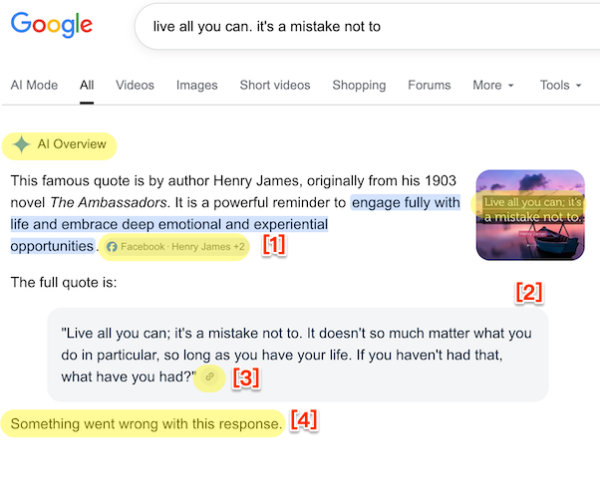
[1] I’m looking for the source of a Henry James quotation, and you give me Facebook?
[2] You give me a meme, and an exceptionally ugly one?
[3] You give me — the link is to a pop-up, who knows why — BrainyQuote?
[4] I’ll say. One of the amazing things about squillionaire feifdom GOOG is how utterly shoddy the sourcing is. What did they suck up all those books for in Google Books if they’re going to source a Henry James quotation to Facebook? It’s as if they want to disorganize all the world’s information, and make it useless and inaccessible.
(I realize that nobody gets the same result from the same search any more, but this is my result; “there are many like it, but this one is mine.”) This time, maybe not next time. You can’t step in the same AI slop twice, as Heraclitus didn’t quite say.)
3 It’s a shop-soiled conservative trope to classify liberal media figures or humanities professors “elites,” especially when working themselves into a fury about something. I won’t address that misclassification here. Suffice to say you’re not elite if you don’t own a substantial amount of economic capital, more than your house, your car, and your 401(k), say, and most people targeted as elites by conservatives don’t meet that criterion, unless they’re successuful policy entrepreners like Larry Summers, for example.
4 “You will, Oscar, you will.”
5 On maintaining their class power, of course, the bourgeoisie is (more or less) united, although there are always exceptions (the Duke of Orleans in 1789 was a class traitor, for example). But remember: In a crisis, all correlations go to one. If indeed there is a general strike in 2028, the various ruling class formations will happily unite and gun the strikers down.